Julia Pierce | August 10, 2026 | Updated August 10, 2026, 9:26 A.M.
For many years, I have heard that there are some cities that have been dubbed “sanctuary cities.” I didn’t know what those were, and maybe you don’t either.
What is a Sanctuary City?
Some of those policies are listed as:
- restricting the ability of state and local police to make arrests for federal civil immigration violations, or to detain individuals on civil immigration warrants;
- prohibiting “287(g)” agreements through which Immigration and Customs Enforcement (ICE) deputizes local law enforcement officers to enforce federal immigration law;
- preventing local governments from entering into a contract with the federal government to hold immigrants in detention;
- preventing immigration detention centers;
- restricting the police or other city workers from asking about immigration status;
- restricting the sharing of certain information on immigrants with the federal government;
- restricting local police responses to federal immigration detainers; and
- refusing to allow ICE into local jails without a judicial warrant.
Summarily, the law enforcement of a county refuses to hold immigrants in state or local jails pending an ICE detainer.
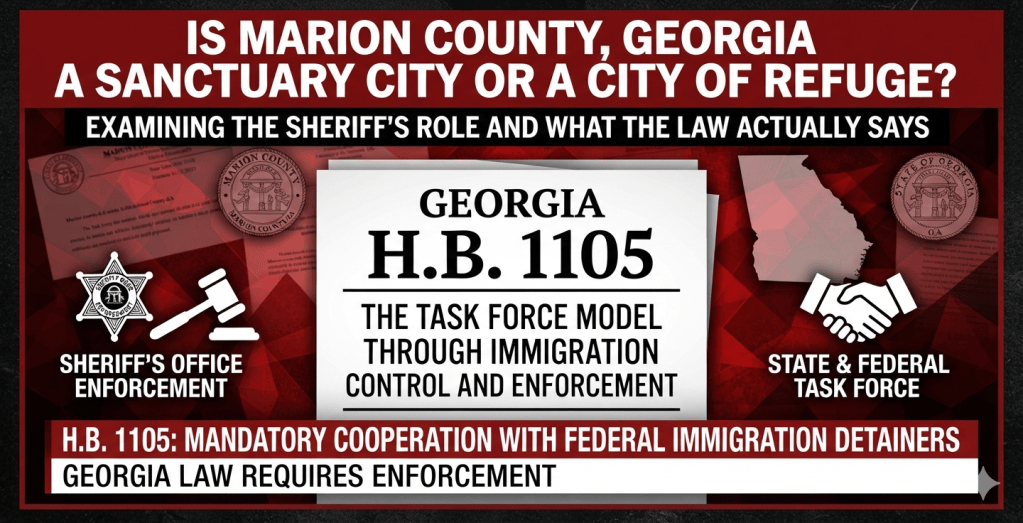
Although the article from the American Immigration Immigration Council, which was written in February of 2025, indicates that participation from a state law enforcement with the federal government regarding ICE, and indicate that doing so may be a violation of the 10th Amendment, a new law, House Bill 1105, signed into law by Georgia Governor Brian Kemp, now requires all Georgia sheriff’s to notify immigration agents when someone has entered into the country illegally.
In Marion’s neighbor county, Muscogee County’s Sheriff Greg Countryman, just recently defended his participation in the 287g program and defended his stand against pro-immigration policy advocates and the council. Countryman stated, “The sheriff’s office comes into contact with ‘very dangerous individuals,’ he said, some of whom are involved with a drug cartel. ‘That’s the main reason for this,’ Countryman said.”
In Harris County, another of Marion’s neighbors, Sheriff Jolley enrolled in the 287g program in the Task Force Model (TFM) Reimbursement plan in April of 2026.
Under the 287g program, sheriff’s offices are eligible to receive the following benefits under the Task Force Model Reimbursement Plan:
$7,500 for equipment per trained TFO
$100,000 for new vehicles per MOA
Salary and benefits reimbursed per trained TFO
Overtime funds up to 25% of salary

19 out of 159 county sheriffs are participating in the Task Force Model, which allows the sheriff to report suspected [undocumented citizens] NOT charged with crimes. 21 Georgia police departments participate in the TFM as well.
17 Georgia counties participate in the Jail Enforcement Model, which “allows … officers to identify and process removable [undocumented citizens] who have pending or active charges.” The Georgia Department of Corrections also participates in this model.
27 Georgia counties participate in the Warrant Services Model, including Harris County, as of May of 2025, which allows the law enforcement agency’s officers “to serve and execute administrative warrants on [undocumented citizens] in [their] custody.
Harris County is the only county in the Chattahoochee Judicial Circuit that participates in both the TFM and the Warrant Services Model.
What is a City of Refuge?
A city of refuge was a city that was dedicated as a place where an individual could seek sanctuary if they had accidentally killed another. Joshua 20:2-3 states, “Tell the Israelites to designate the cities of refuge, as I instructed you through Moses, so that anyone who kills a person accidentally and unintentionally may flee there and find protection from the avenger of blood.”
What is an avenger of blood?
An avenger of blood (go’el ha-dam) is the nearest male relative of a murdered person who was legally responsible and obligated to execute justice by putting the killer to death.
When the avenger of blood comes to that city and asks the elders in that city to turn over the killer, they are not required to do so. In fact, the accidental slayer is allowed to stay in that city until the high priest from the city from which he or she fled dies. This meant that there would be no more consequence for the one who accidentally killed another.
However, a city of refuge had a requirement that if the individual who sought sanctuary intentionally murdered another, they were to deny access to that individual, and if they found out that someone within their gates was guilty of intentional murder, they were to throw that individual out of their city, so that the avenger of blood could be satisfied.
Numbers 35:19-21 states, “The avenger of blood shall put the murderer to death; when the avenger comes upon the murderer, the avenger shall put the murderer to death. If anyone with malice aforethought shoves another or throws something at them intentionally so that they die or if out of enmity one person hits another with their fist so that the other dies, that person is to be put to death; that person is a murderer. The avenger of blood shall put the murderer to death when they meet.”
Deuteronomy 19:11-12 states, “But if out of hate someone lies in wait, assaults and kills a neighbor, and then flees to one of these cities, the killer shall be sent for by the town elders, be brought back from the city, and be handed over to the avenger of blood to die.”
Summarily, the town elders are to only harbor those who were innocent of murder, as such is the case today as involuntary manslaughter or criminally negligent homicide. They were not supposed to harbor those who committed malice murder or homocide.
It has been stated that Marion’s sheriff, Derrell Neal, has obstructed at least one investigation in the disappearance of Paul Akins, who was last seen with Kristy Grier and Scott Craft, a registered sex offender.
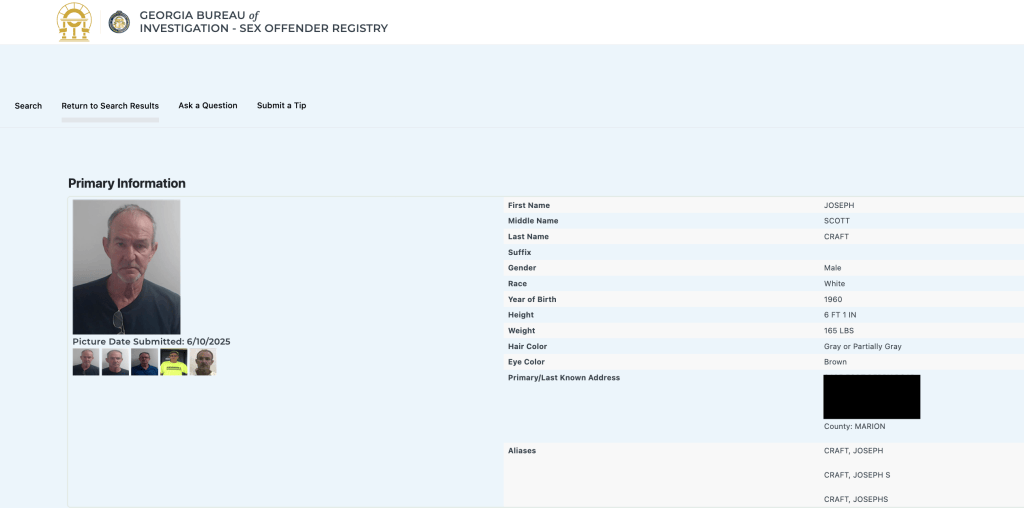
The CPD detectives have indicated that Neal will not grant them authority to investigate the matter with the Crafts and Ms. Grier. Why would Neal obstruct them from this investigation if it could bring justice and peace to the family of Paul Akins?
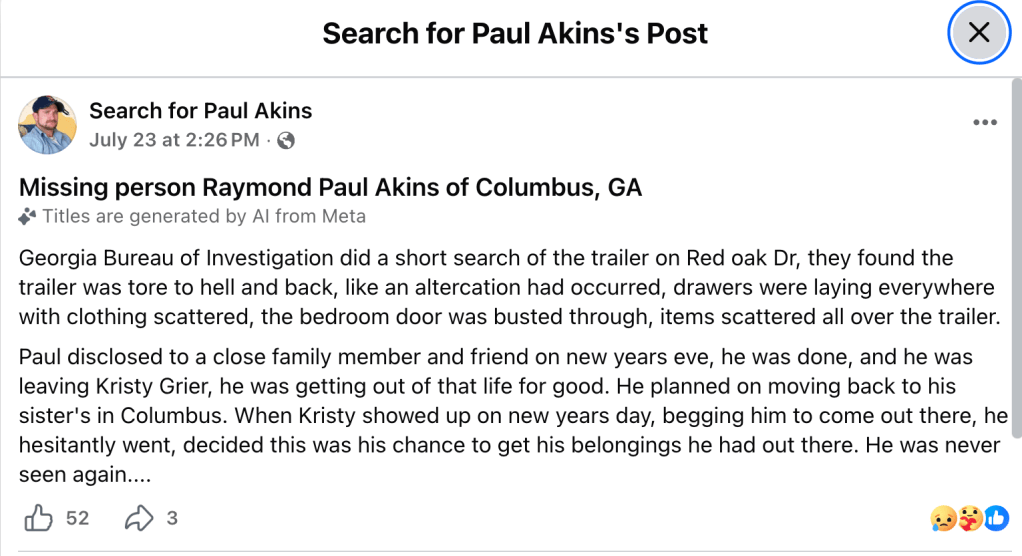
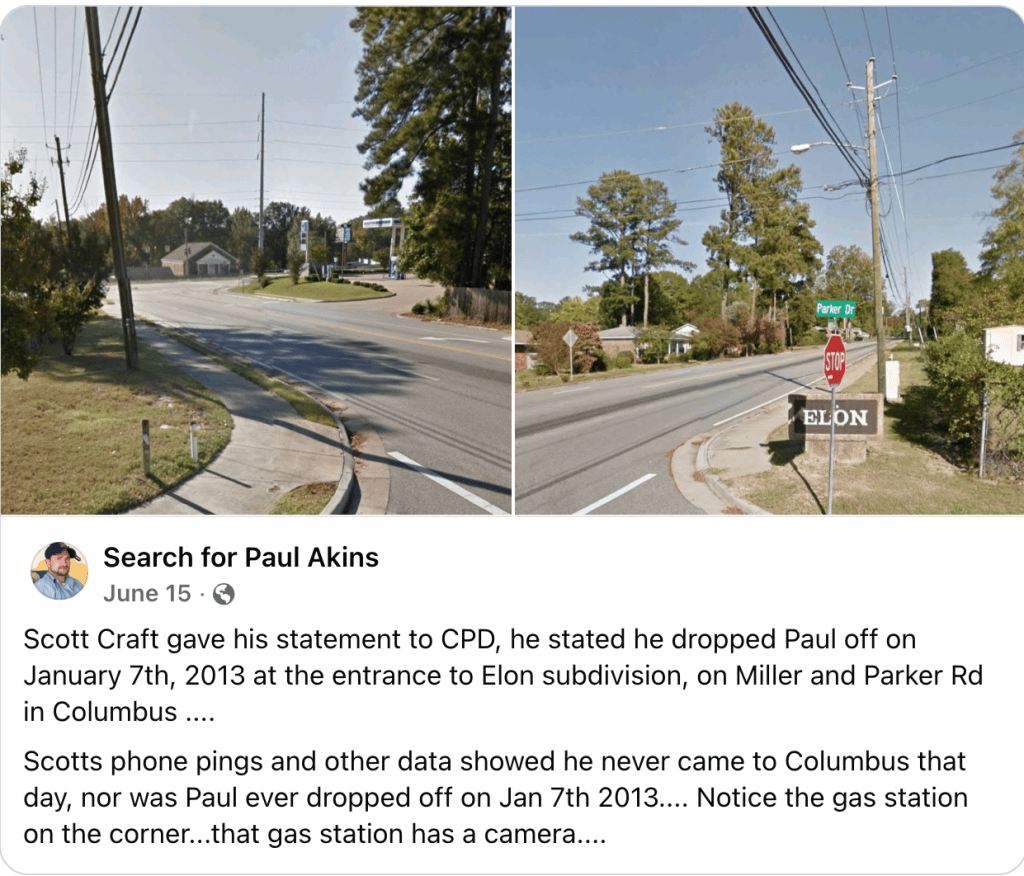
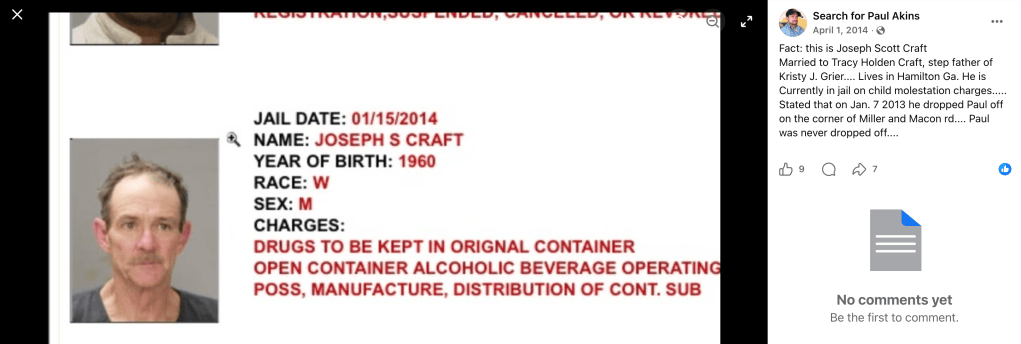
So, Does Derrell Neal, the Sheriff of Marion County operate a Sanctuary City or a City of Refuge? You be the Judge.
In order to discern this, we need to ask a few questions.
- Does Neal harbor violent offenders?
- Does he harbor undocumented citizens?
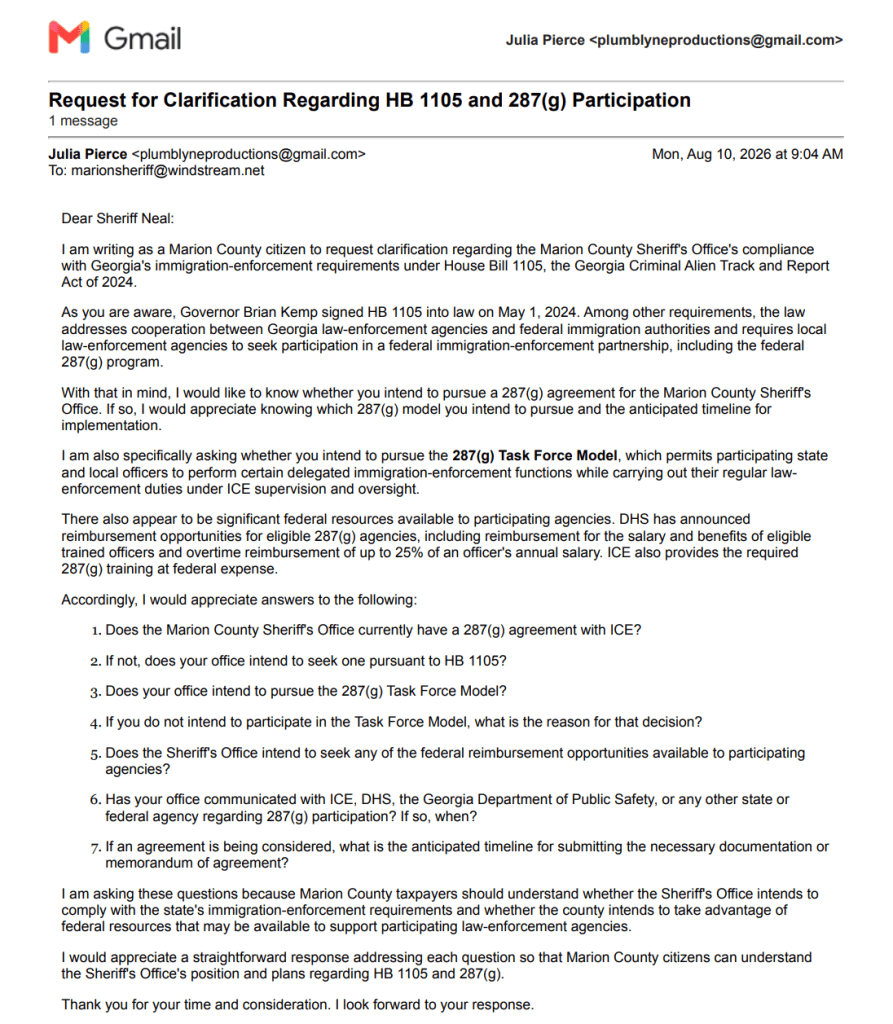
- Does he refuse to participate with the state law that requires him to participate with Immigration Control and Enforcement via HB1105?
- Does he refuse to arrest violent criminals (cartel members, drug and human traffickers, pedophiles, murderers, domestic violators) and/or return them to their original jurisdiction?
- Does he refuse to participate in cross-jurisdictional investigations involving those seeking sanctuary or refuge in his city, as such is the case of Paul Akins?
I have reached out to sheriff Neal for answers.
What are your thoughts?
If you have a story, feedback, or questions, please feel free to contact me at Plumblyne Productions by email at plumblyneproductions@gmail.com or call me at 229-329-2179. Don’t forget to subscribe, share, and follow to stay up to date.


Leave a Reply