Julia Pierce | August 9, 2024
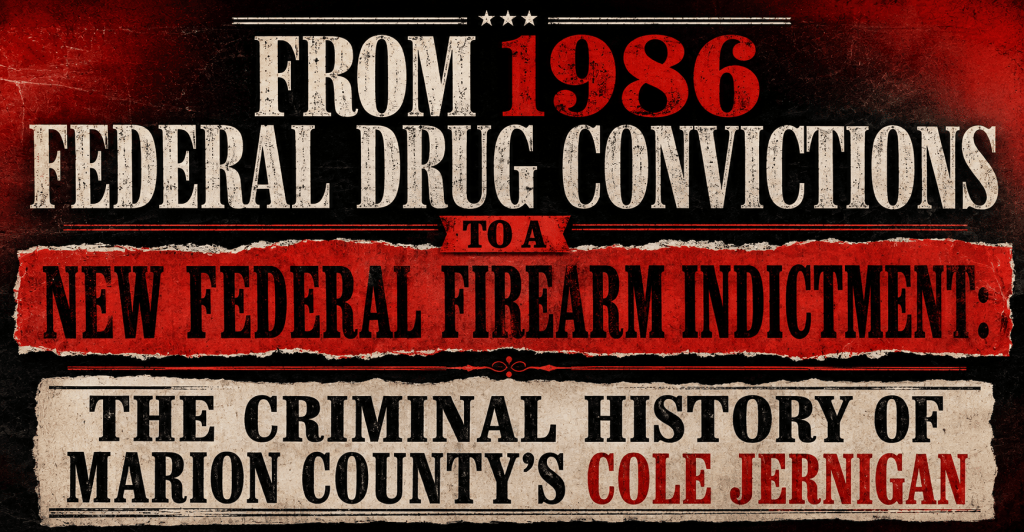
On May 10, 2026, I wrote a publication that presented evidence that Cole Jernigan, of Jernigan Farms, was indicted and was awaiting a federal trial regarding the charge of possession of a firearm by a convicted felon.
What I, and other citizens didn’t know, is why Mr. Jernigan was considered a convicted felon and for what he was convicted. Several archived news articles from The Atlanta Constitution reveal that Mr. Jernigan, along with former-sheriff of Marion County, Joseph Clide Grier, and Robert Wells, who worked for Mr. Jernigan, were arrested on December 8, 1985, and charged with Conspiracy to Import 200kg of cocaine and with conspiracy to distribute cocaine.
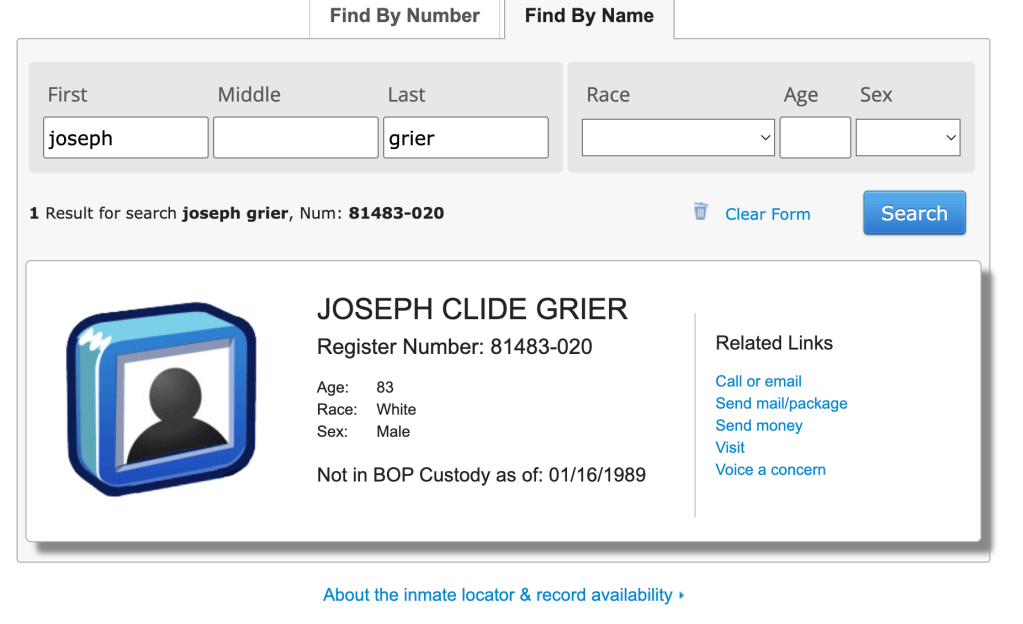
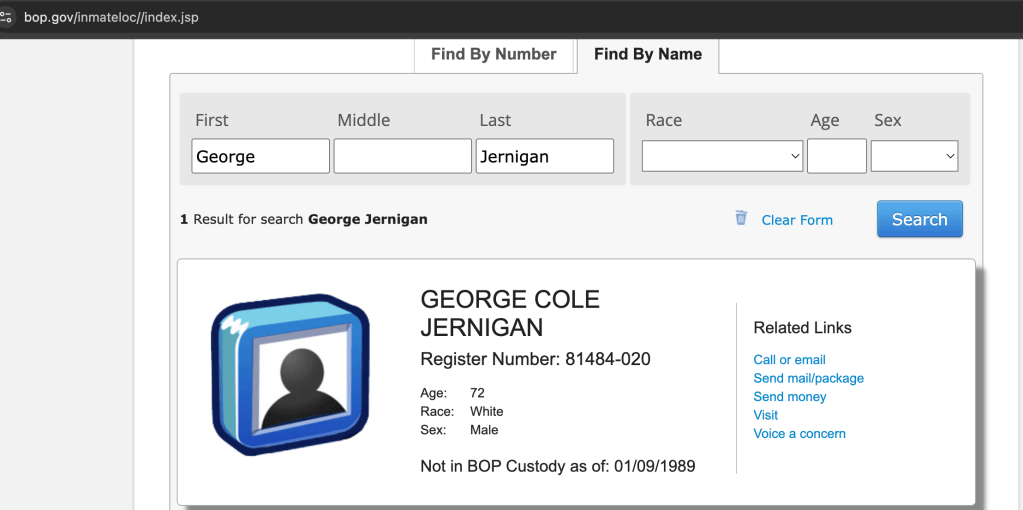
Mr. Jernigan was sentenced to two concurrent seven-year terms of imprisonment in a federal penitentiary. Separately, disgraced former Marion County Sheriff, Joseph Clide Grier, was sentenced to two concurrent five-year terms of imprisonment in federal prison. Neither of them served their entire terms, barely making it to three years of imprisonment.
Timeline of Events
December 9, 1985
Kevin Sack and David Beasley, writers for The Atlanta Constitution, indicated that the sheriff of Marion County, Joseph “Clide” Grier, was paid $10,000 two weeks prior in the parking lot of a hotel in Columbus, and promised another $50,000 in “protection” money to allow a “cocaine-laden” plane to land at the Marion County air strip in Buena Vista, Georgia.
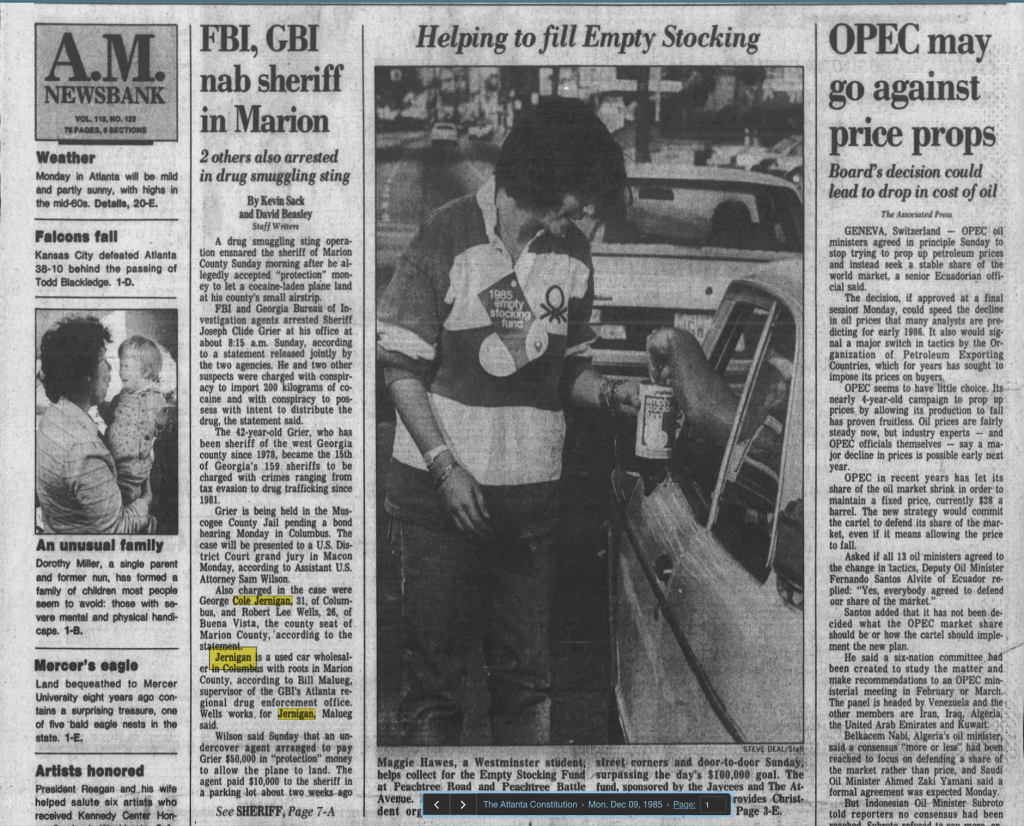
The article explains that Mr. Jernigan and Robert Wells were waiting at the airstrip to “unload cocaine from the plane.” Jernigan and Wells loaded duffel bags filled with what they believed were cocaine and drove them to Jernigan’s farm in Marion County. These bags were filled with flour by the undercover agent with the FBI. The pilot and the Colombian drug-smuggler were undercover.
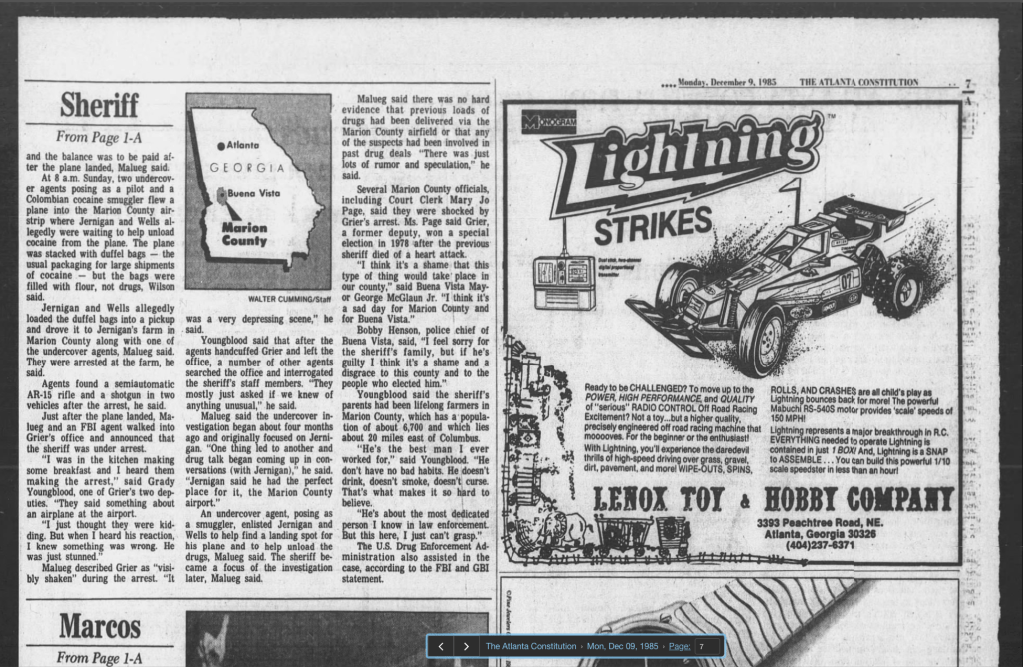
The investigation had begun approximately four months prior to the arrest and was intended to focus on Cole Jernigan, where “drug talk” kept coming up pertaining to Mr. Jernigan. The DEA, FBI, and GBI all participated in the case against Jernigan, Grier, and Wells, though later testimony by Grier would suggest that he was performing his own drug investigation, which was debunked with evidence by FBI agents.
December 10, 1985
Roger Ann Jones, from The Atlanta Constitution, wrote about the effect that Sheriff Grier’s drug arrest had on Marion County. They stated that Jernigan and Grier each posted a $10,000 bond and Wells was released on a $5000 bond.
Later that day, a Macon federal grand jury indicted each of them on one county of conspiracy to import and conspiracy to possess drugs with the intent to distribute.
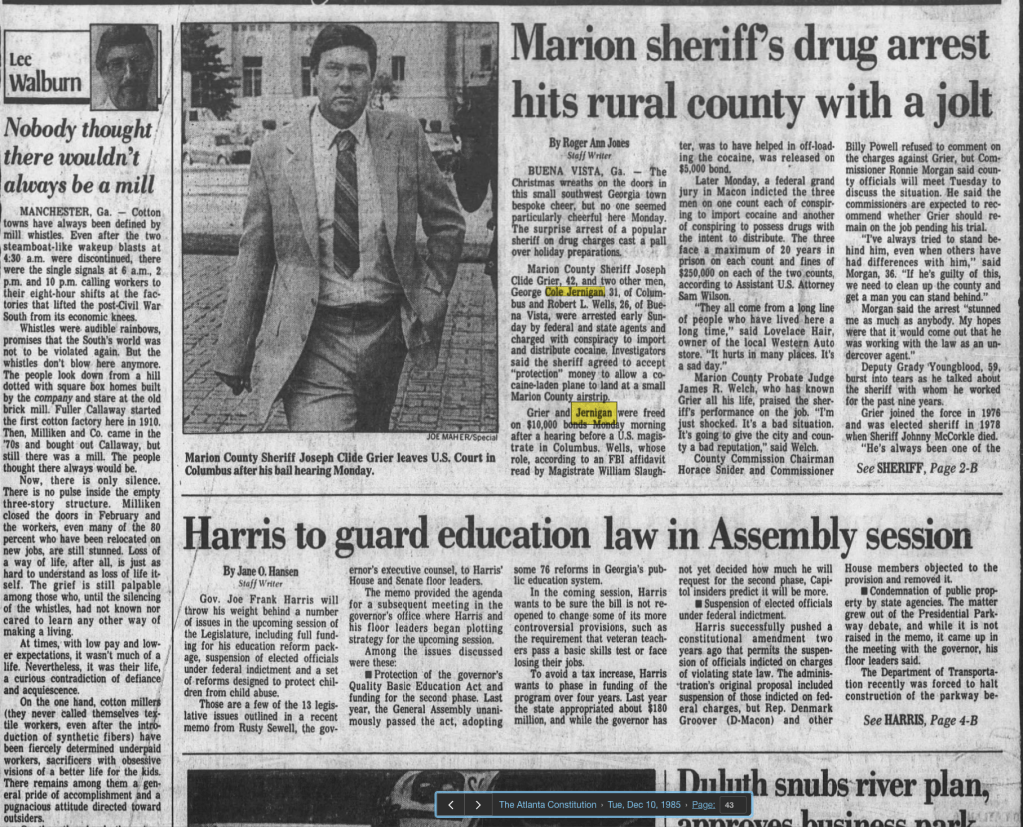
The Marion County commissioners, as written, were scheduled to discuss whether sheriff Grier would return to his active duties pending his trial.
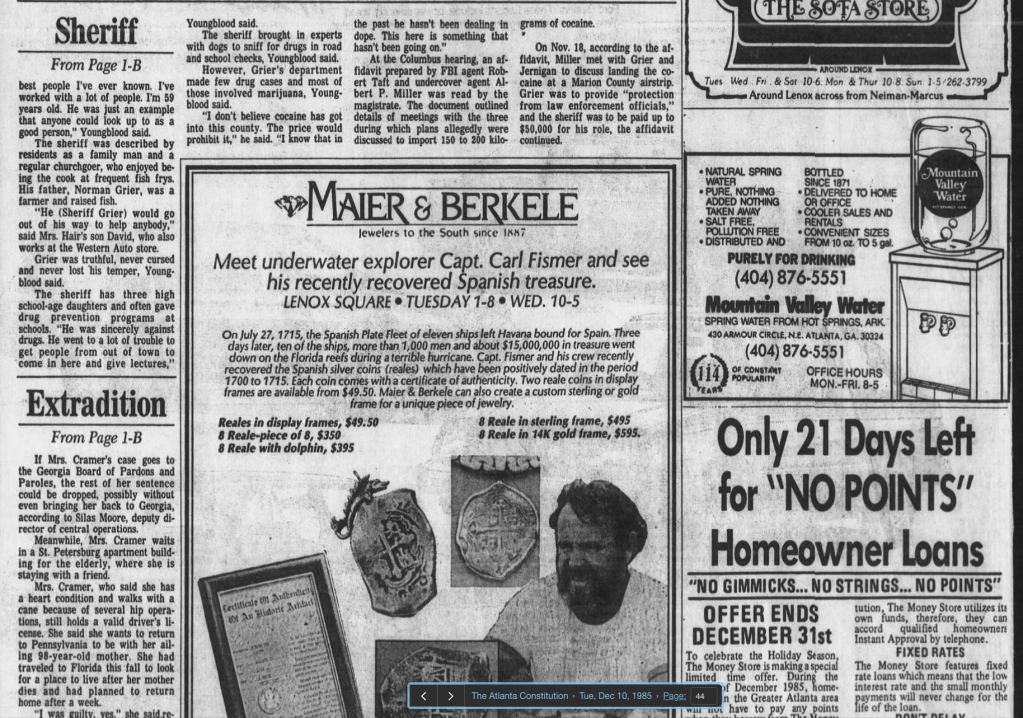
The article further states that undercover FBI agent Albert P. Miller, which should actually be Albert D. Millard, met with Jernigan and Grier on November 18, 1985 to discuss the details of “landing the cocaine at a Marion County airstrip” and that Grier was to be paid $50,000 to provide “protection from law enforcement officials.”
December 11, 1985
The commissioners of Marion County indicated that they wanted Coroner Herbert Tante to step into the role as acting sheriff if Sheriff Grier was suspended from his “post while federal drug charges are pending against him.” They also asked the GBI to investigate complaints that they had received by prisoners pertaining to the “operation of the county jail.” Marion County Board of Commissioner Chairman, Horace Snider, indicated that they had received a letter from the governor directing the complaints to the commission, prior to sheriff Grier’s arrest.
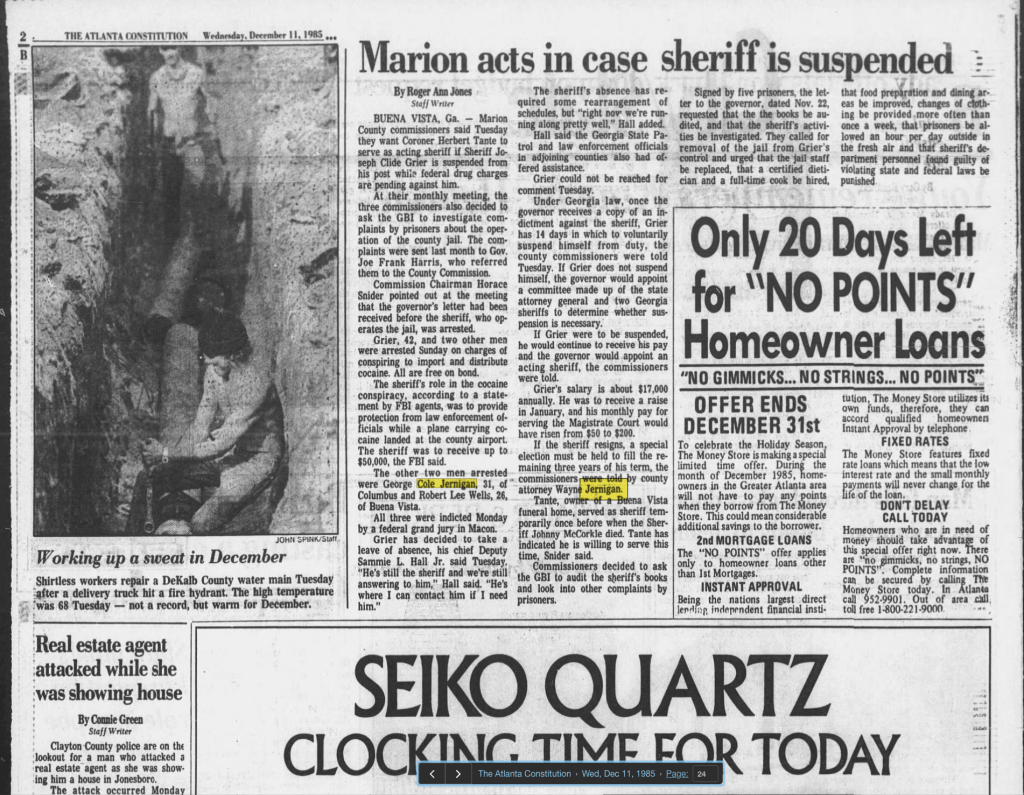
The article further states that Grier “decided to take a leave of absence.” The commission was told that after the Governor had received the indictment, Grier had 14 days to voluntarily suspend himself, in which he would receive his pay, and the governor would appoint a replacement, until a special election could be held, according to Cole Jernigan’s uncle, Wayne Jernigan, who was and still is the county attorney.
***As a side note here, there are a couple of instances where I see that Wayne Jernigan, as the county attorney has been doing the right thing. He knows the law. And I have seen that his relationship to Jernigan has not appeared to be an area of compromise due to family ties. That is commendable and it gives way to a new respect and a change of heart towards him.***
The GBI, in addition to looking into the prisoners’ complaints, were asked by the commission to look into the sheriff’s record keeping and perform an audit.
December 14, 1985
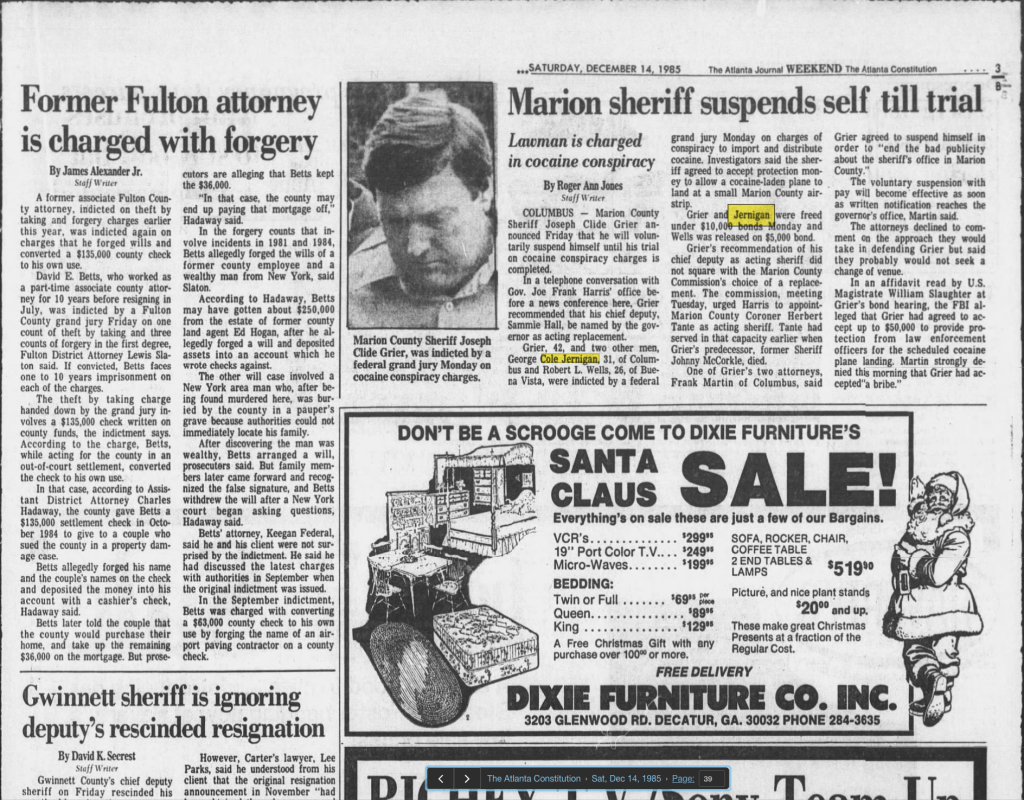
According to James Alexander Jr., eleven days before Christmas, Sheriff Grier announced his voluntary suspension “until his trial on cocaine conspiracy charges,” in what his attorney, Frank Martin, the father of Superior Court judge, John Martin, indicated was to spare the county any further “bad publicity.”
December 20, 1985
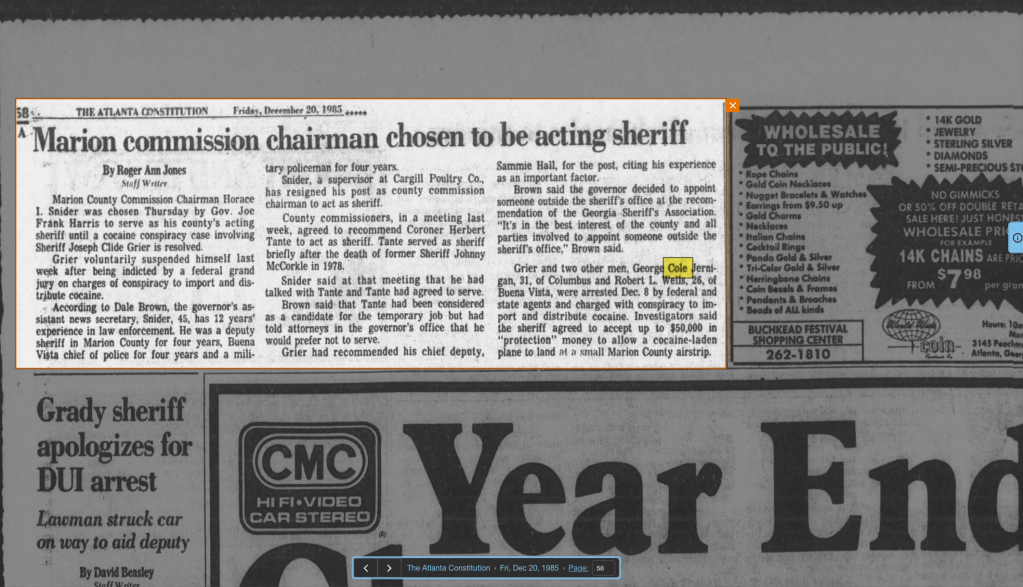
Horace Snider was chosen by Governor Joe Frank Harris to replace Joseph Clide Grier as Marion County’s Sheriff. Horace served the citizens of Marion County for almost 28 years as Marion’s sheriff, prior to Derrell Neal’s election as Marion’s most recent sheriff. Snider was also police chief of Buena Vista for four years and a military policeman for four years.
In order to step into the acting sheriff’s role, Horace resigned his seat as chairman of the Marion County Board of Commissioners. Governor Harris decided “at the recommendation of the Georgia Sheriff’s Association” to appoint “someone outside the [Marion County] sheriff’s office.”
March 4, 1986
Grier’s attorney, Frank Martin, held up a “manila folder filled with $100 bills” at a hearing in federal court and “insisted that the cash was evidence instead of bribe money.” Martin did his best to present the appearance that Grier was performing an investigation of his own and that the money he had taken as a bribe – the $10,000 from the undercover agent at the hotel in Columbus posing as a Colombian cocaine smuggler – was evidence instead.
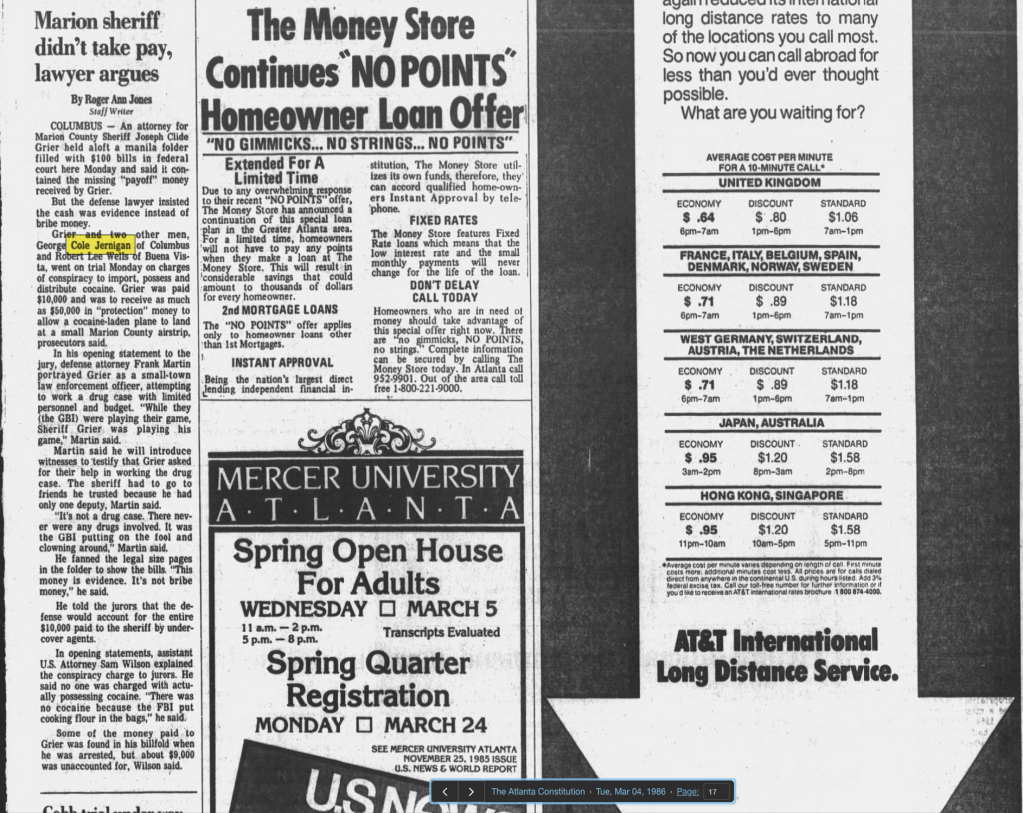
U.S. Attorney Sam Wilson explained that “some of the money paid to Grier was found in his billfold when he was arrested, but $9000 was unaccounted for.”
March 5, 1986
George Cole Jernigan testified that he “had paid Grier $500 for tipping him off about Georgia Bureau of Investigation agents watching Jernigan’s marijuana field one year.” Jernigan also gave the sheriff $200 and $300 dollars “at other times.”
FBI agent Millard indicated that he was threatened by Grier who stated, “he had no use for a pimp, or rat, and he wanted to let me know that if I set him up to get caught, that he would kill me before we [he and his conspirators] went to prison.”
Agent Millard played a series of tapes made during discussion between the undercover agents and Grier, Jernigan, and Wells, in which he indicated that Grier requested an additional $25,000 on top of the $50,000 that he was already anticipating receipt of at the end of the deal. Millard indicated that Grier said he would take it in either cash or cocaine and he didn’t care which.
The article states further that Jernigan is who contacted Grier regarding the Colombian cocaine drug smuggling operation and allowed them access to his farm to split up the drugs.

March 6, 1986
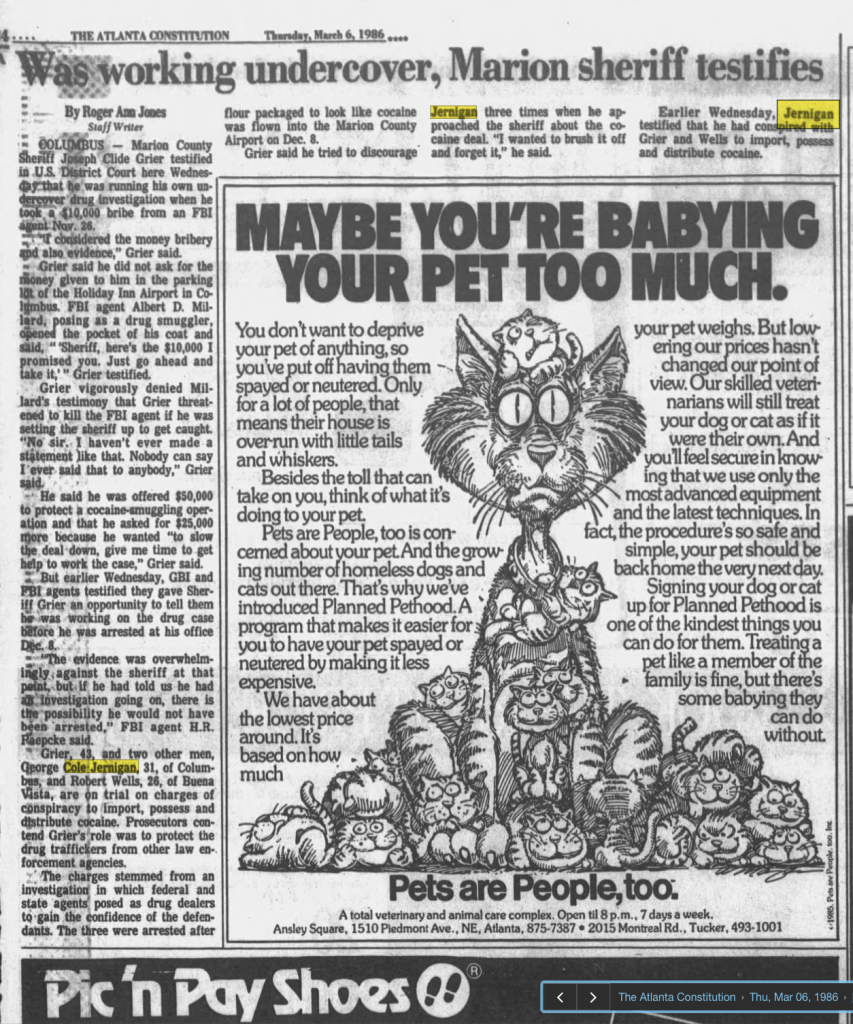
Grier testified in court that he was running his own drug investigation when he took the bribe from the FBI agent on November 26, 1985, citing it was “bribery and also evidence.” Grier also indicated that agent Millard, presenting himself as a Colombian drug smuggler, said, “Sheriff, here’s the $10,000 I promised you. Just go ahead and take it,” referring to the money Millard had inside his jacket pocket that he had “placed on the hood of his car.” Grier also adamantly denied threatening to kill Agent Millard.
The article expands on the extra $25,000 in cocaine or cash that Grier requested on top of the $50,000 he was promised. Grier said he asked for the $25,000 “to slow the deal down, give [him] time to get help to work the case,” yet the FBI agents noted that they gave Grier the opportunity to let them know that he was working the case before he was arrested and mum was the word. The FBI agents indicated that if Grier had told them he had been working his own drug investigation, there was a possibility he would never have been arrested.
Grier further stated in court that he tried to “discourage Jernigan three times when he approached the sheriff about the cocaine deal.”
Jernigan testified that he had in fact conspired with Grier and Wells regarding the operation.
March 7, 1986
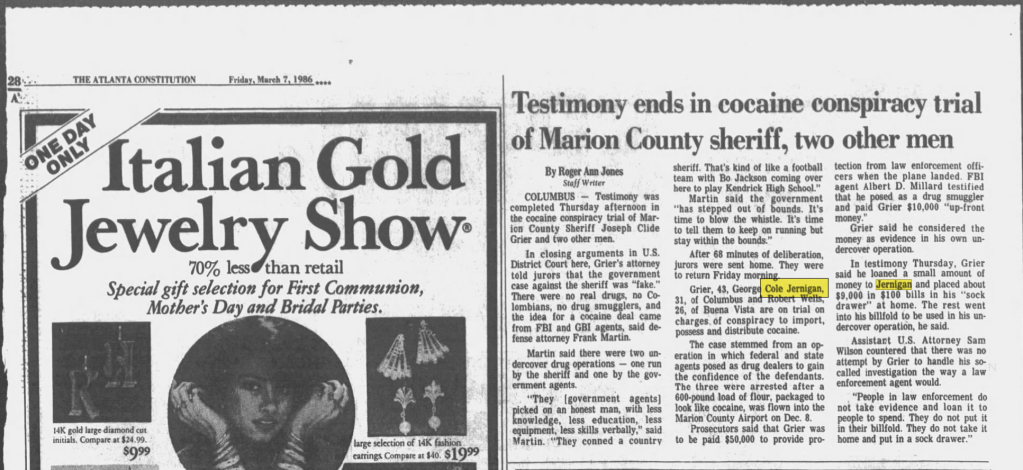
On the last day of trial, Grier indicated that he had loaned a “small amount” of the “up-front” protection money to Jernigan and “placed about $9000 in $100 bills in his “sock drawer at home,” where the rest of the money was found in his billfold upon his arrest.
U.S. Attorney Wilson stated that Grier made no attempt to follow the procedures the way a trained “law enforcement agent would,” when referencing what Grier maintained was his own drug investigation.
Wilson stated, “People in law enforcement do not take evidence and loan it to people to spend. They do not put it in their billfold. They do not take it home and put [it] in a sock drawer.”
I would have to agree with Wilson. Evidence belongs in an evidence locker. Why would Grier loan the “protection money” to Jernigan who was involved in the conspiracy if he was performing an investigation into Jernigan?
March 8, 1986
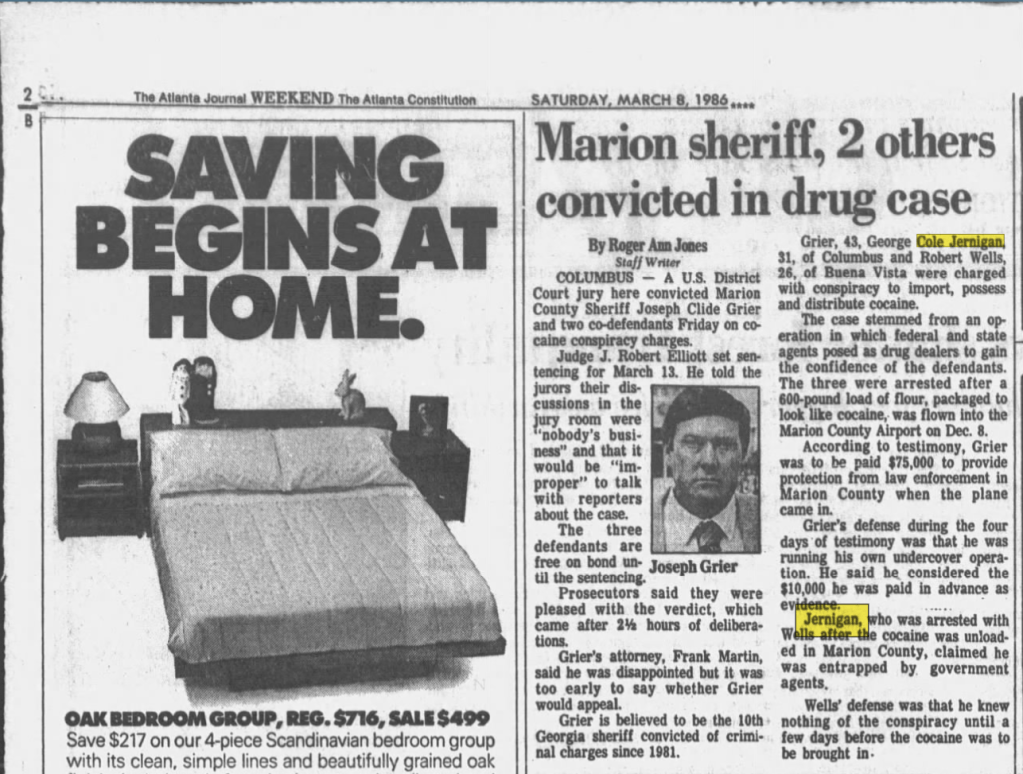
A Marion County jury convicted all three men on cocaine conspiracy charges, whereby sentencing was scheduled for March 13, 1986. Grier had maintained that he was running his own investigation, Jernigan maintained that he had been “entrapped by government agents,” and Wells said he knew nothing of it “until a few days before the cocaine was to be brought in.”
It is true that there was no actual cocaine on the plane; however, the fact that Cole was willing to work with someone he believed to be a Colombian drug smuggler to import cocaine and bribe the local sheriff to look the other way, and in turn provide protection and a heads up pertaining to GBI investigations regarding his marijuana fields, indicates that he still had intent and carried it out as though it were legitimate. Just because it was an undercover sting does not do away with intent. In the criminal world, most crimes have to be proven by intent. If there was intent, then there can be a conviction. If there is no intent, then there may not be, depending on the type of crime.
March 14, 1986
Judge J. Robert Elliot sentenced Grier to two five-year concurrent terms in a federal prison, stemming from the two-count conviction. Grier barely served three years.
Wells was sentenced to two two-year concurrent terms in a federal prison.
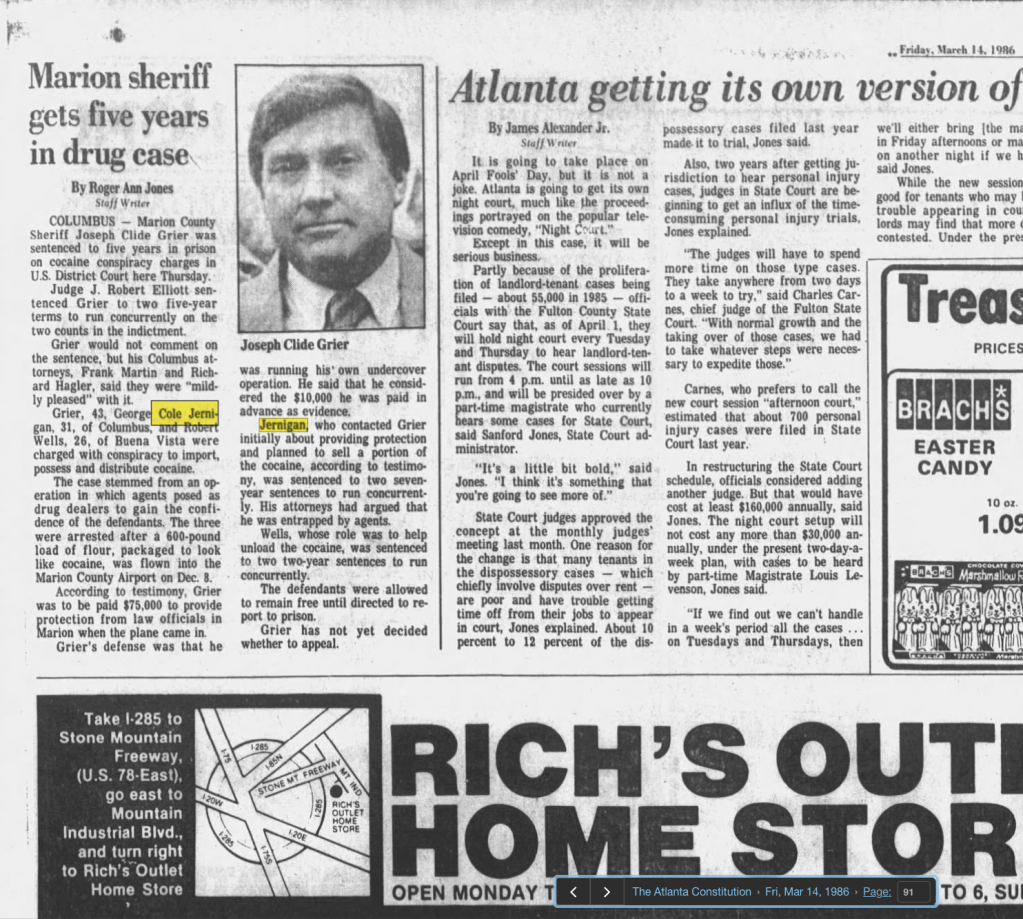
Jernigan was sentenced to serve two seven-year concurrent terms in a federal prison in which he barely served three years of that sentence. All were allowed to “remain free until directed to report to prison.”
In Summary
Cole Jernigan admitted that he paid a former sheriff to look the other way and tip him off of GBI investigations in to his marijuana fields. Cole Jernigan admitted that he conspired with the sheriff about the importation of cocaine from Colombia. Cole Jernigan admitted that he would allow the drug smugglers to use Jernigan Farms to split up the cocaine for distribution and took the smuggled bags to his farm to do so.
So my question is, if Cole did that then, what’s to stop him from doing it now? Could he potentially be paying our current sheriff to do the same thing that he paid Grier to do? Why would Cole try to bribe me to take down my report about his current indictment if he was innocent as his ex-wife Misha says? Why would Misha Jernigan threaten me if I did not take it down?
If Cole has learned his lesson, why was he so quick to still use bribery with me? Does he still assist in the importation, possession, and distribution of illegal drugs in Marion County? Does he still have marijuana fields on his farm?
Would this explain why there are so many drugs in our county and our sheriff turns a blind eye to them?
What do you think?
If you have a story, feedback, or questions, please feel free to contact me at Plumblyne Productions by email at plumblyneproductions@gmail.com or call me at 229-329-2179. Don’t forget to subscribe, share, and follow to stay up to date.


Leave a Reply