August 6, 2026
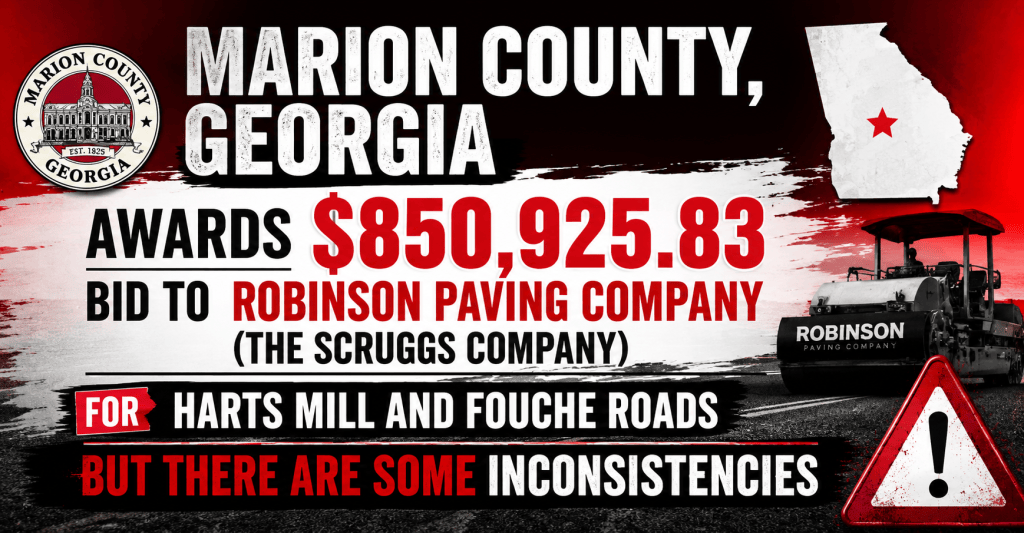
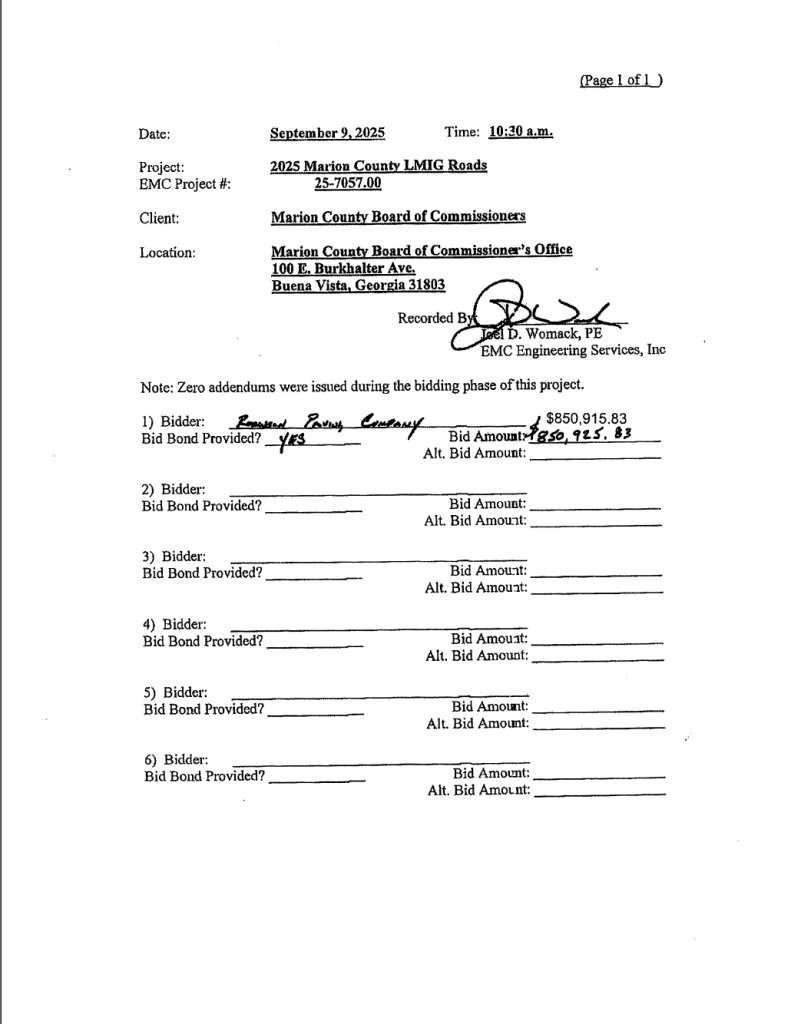
The Board of Commissioners gave their approval four times for the repair of 1/2 mile of Fouche Rd and three approvals were given (one in 2023, one in 2024, and one in 2025) for Harts Mill Rd. The last approval for Harts Mill Road and Fouche Road was approved in July of 2025; however the bid I was provided through an Open Records Request to the Board of Commissioner’s county manager’s clerk, Heather Wright, indicates that the bid was not sent by Robinson Paving Company, which was acquired by the Scruggs Company in August of 2024, in until September 9, 2025, and it wasn’t approved until October 20, 2025.
This presents the question that must be asked, “Why was a bid approved in July of 2025 by the commissioners, when it wasn’t sent in until September of 2025, which was three months later?” And another question is “Why was there no mention of any bid in September or approval of one in October in the Meeting Minutes in 2025?”
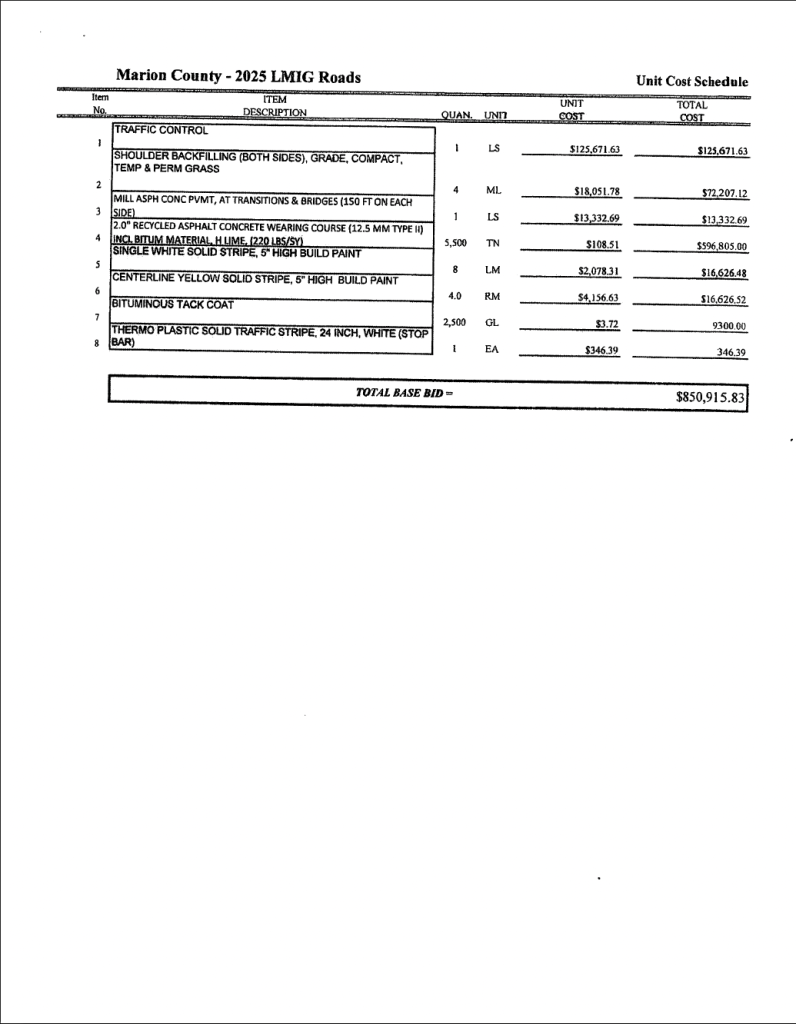
When I looked at the bid proposal and approval, I noticed that the cost of 1/2 mile of resurfacing and all it entailed for Fouche Road along with 2.9 miles of resurfacing for Harts Mill Road and all it entailed was provided as $850,915.83, but it appears that a different amount was written in ink that is not reflected in the bid breakdown.
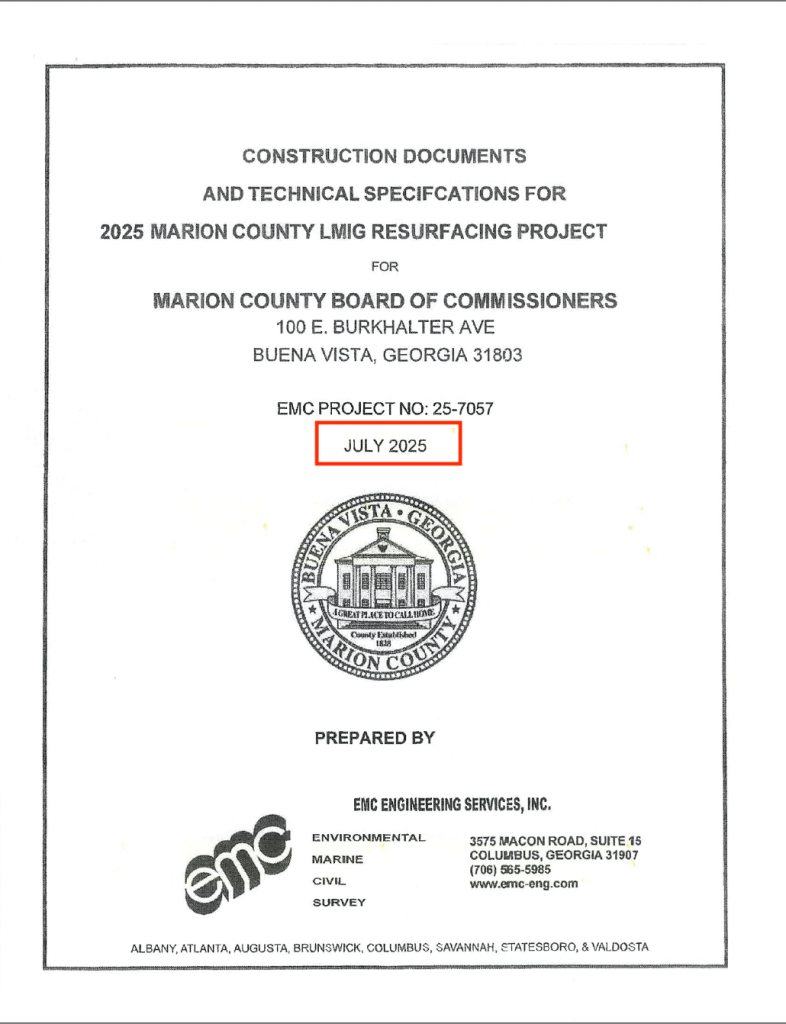
The Construction Documents for the 2025 LMIG Resurfacing Project says it was prepared in July of 2025 by EMC Engineering Services, Inc. As a side note it says “Specifcations” instead of “Specifications.” I guess the preparer didn’t use spell check or review the document before presenting it.
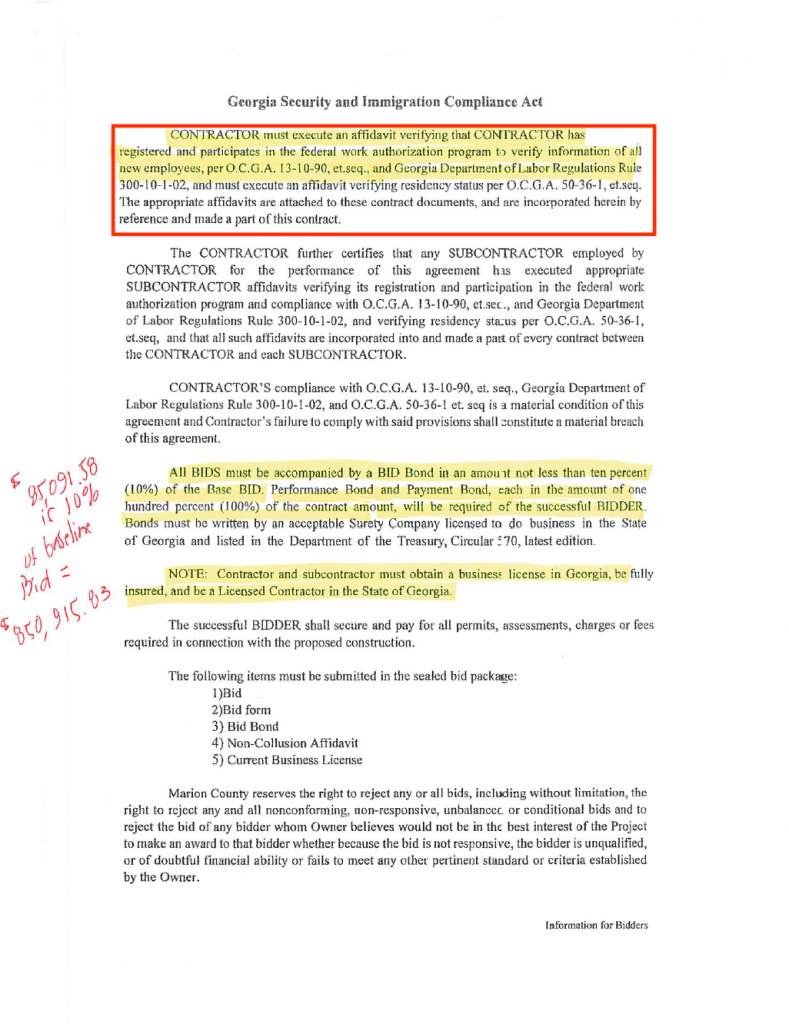
Then, the Robinson Paving Company/The Scruggs Company is required to present an affidavit stating that they are registered and participate in a federal work authorization program.
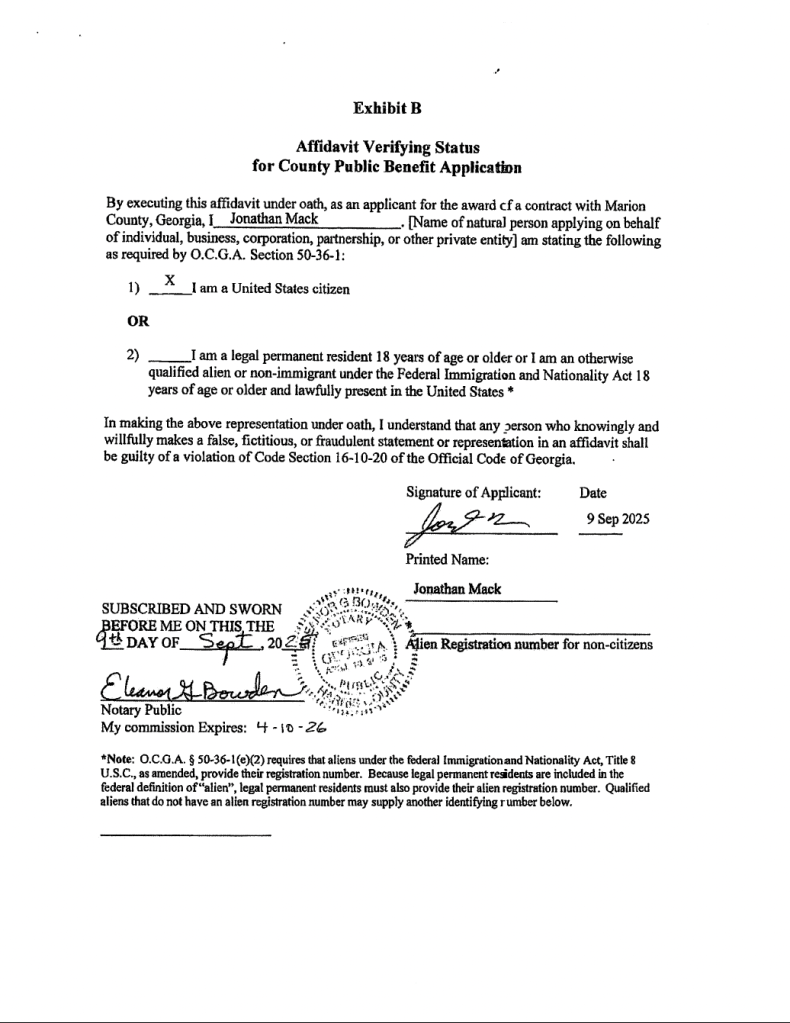
This affidavit indicates that The Scruggs Company and it’s employees and contractors are lawful citizens and are registered with the federal work program.
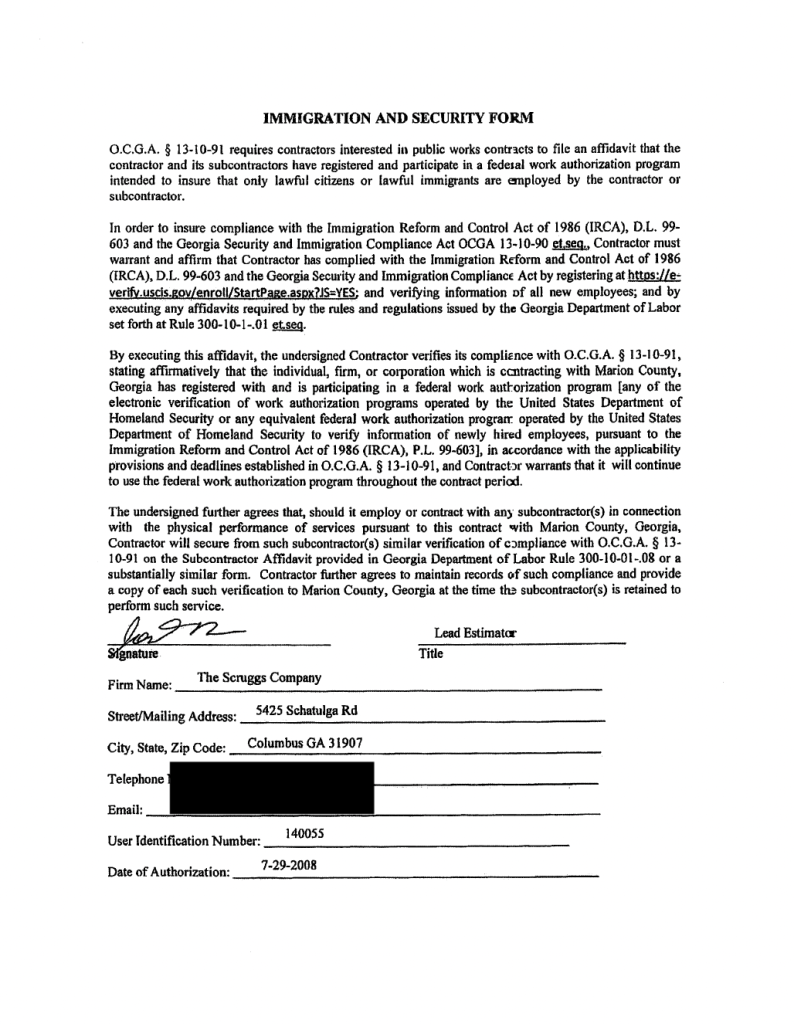
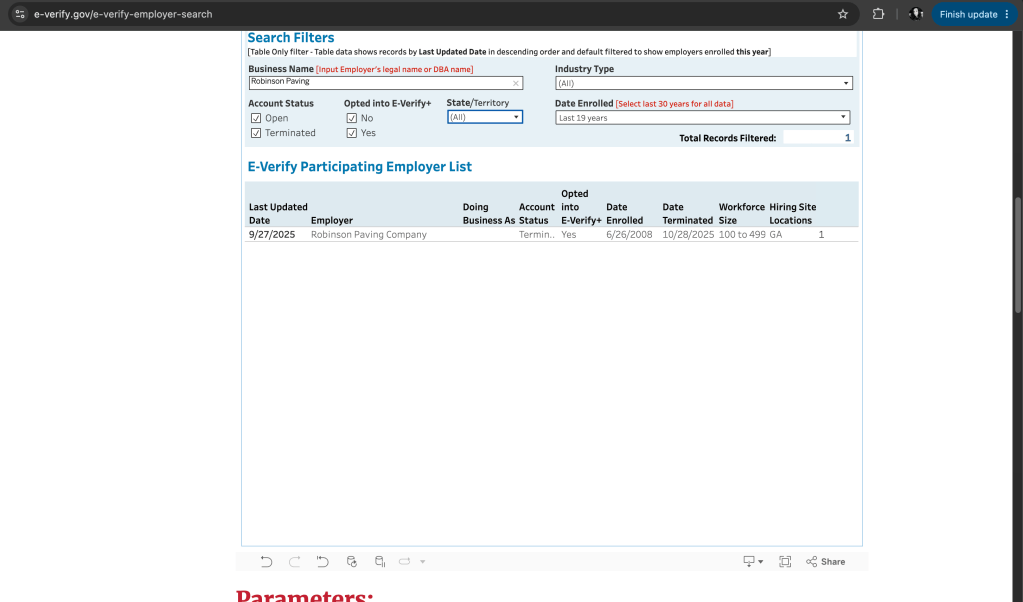
What I found interesting is that The Scruggs Company was last authorized for the Federal Work Authorization Program on February 27, 2025, so why did Johnathan Mack indicate that his date of authorization was July 29, 2008?
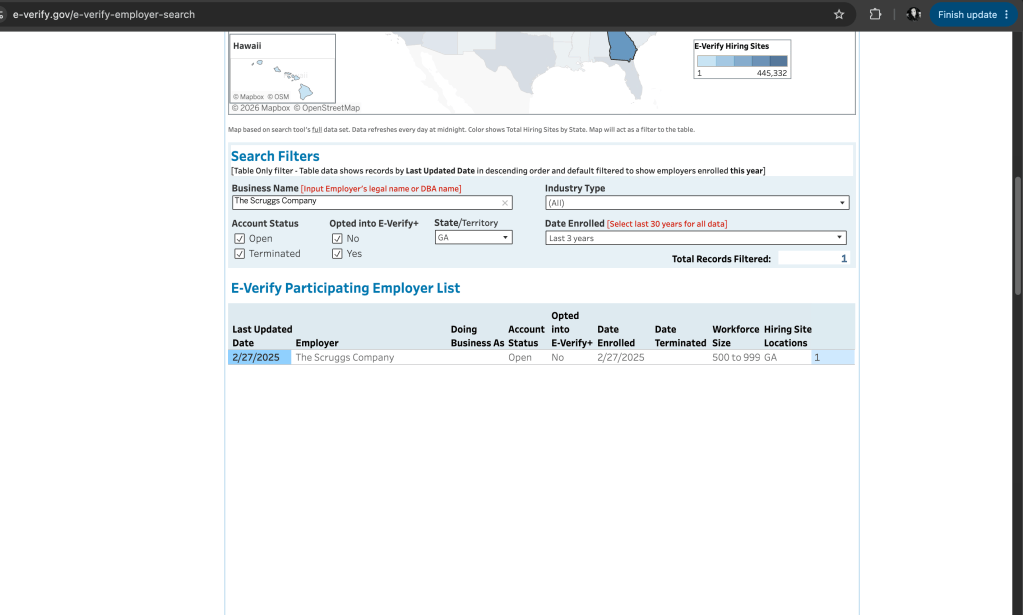
I also found that Robinson Paving Company was authorized June 6, 2028, but he indicated that he was authorized on July 29, 2008? Why would he have not put the correct information in if he was using the authorization date for Robinson Paving Company which shows it was terminated on October 28, 2025?
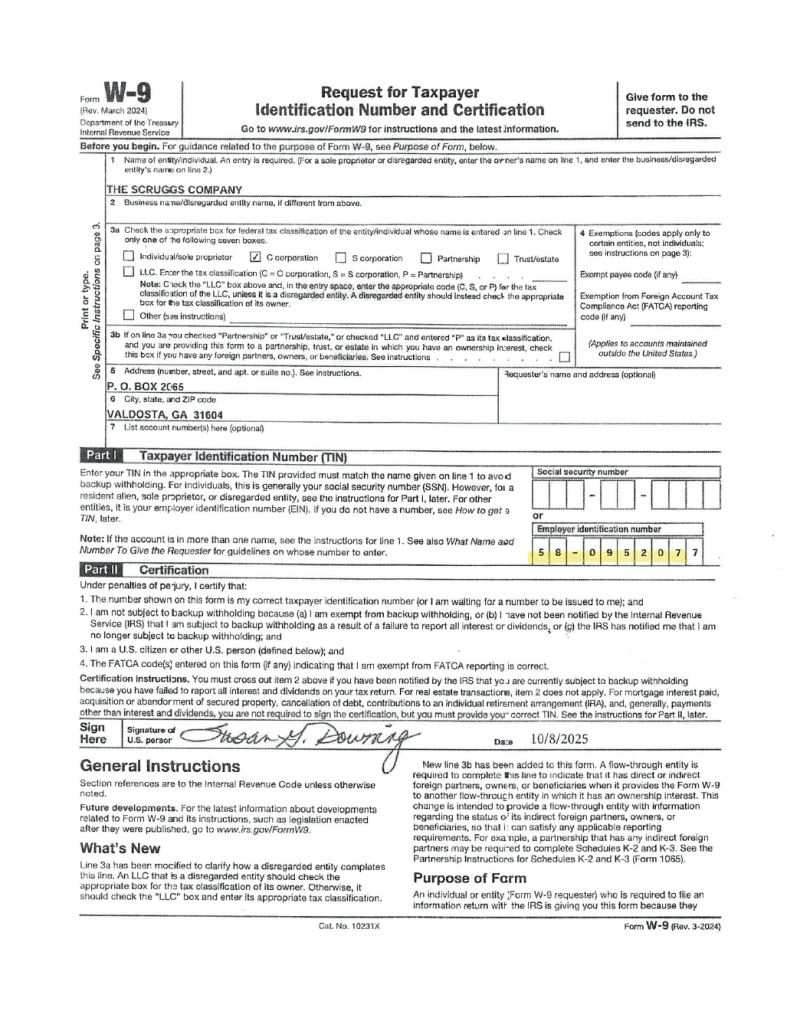
Also, I was provided the application for a Federal Tax ID number for The Scruggs Company on October 8, 2025, but The Scruggs Company had been in business since 1965, according to their website.
How could Robinson Paving have been acquired by The Scruggs Company in August of 2024 and have been paying employees or subcontractors and filing their taxes if they did not have a Federal Tax ID number until their application on October 8, 2025, and we don’t know if it was approved or when it was approved?
Robinson Paving Company/The Scruggs Company was also required to provide a bid bond that covered 10% of the base bond, which is $85,091.58; however, the bond, provided by Western Surety/Liberty Mutual only covered 5% of the base bid, which was in violation of the requirements of the bid to be approved.
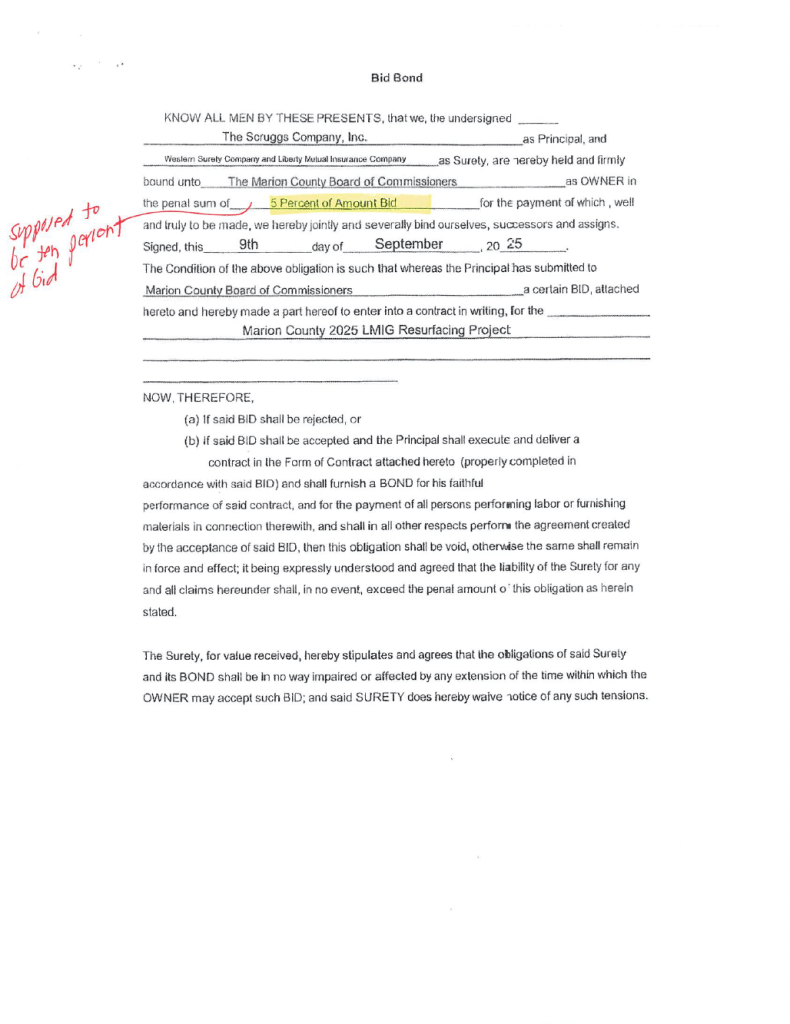
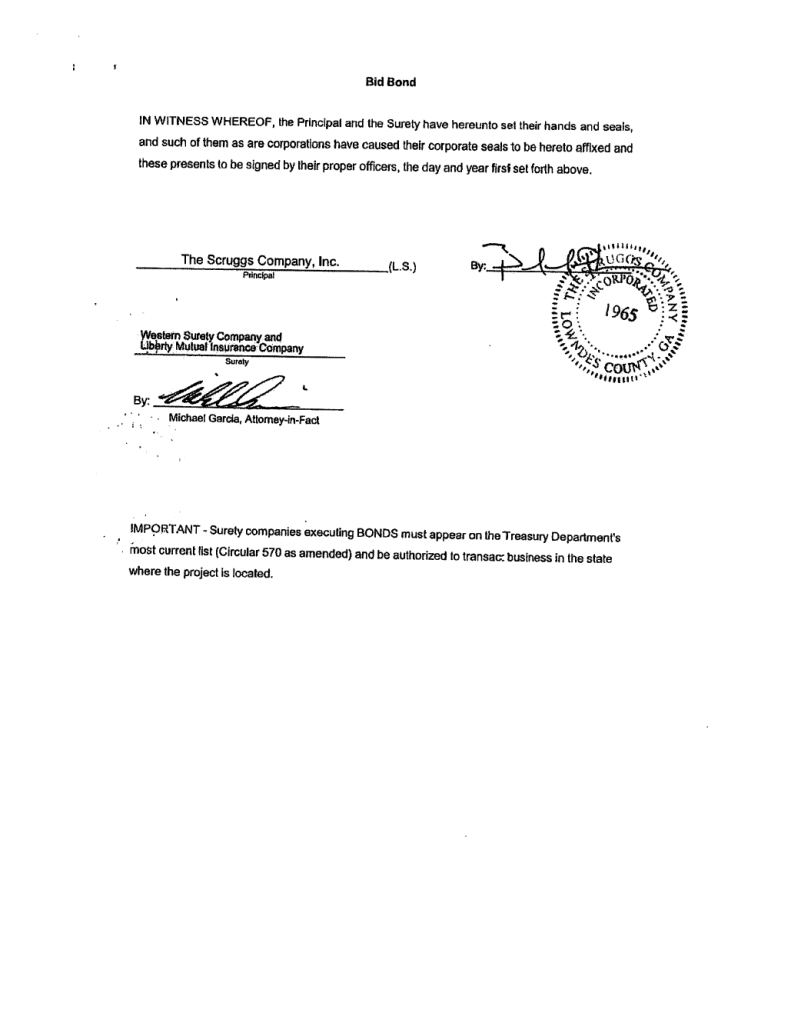
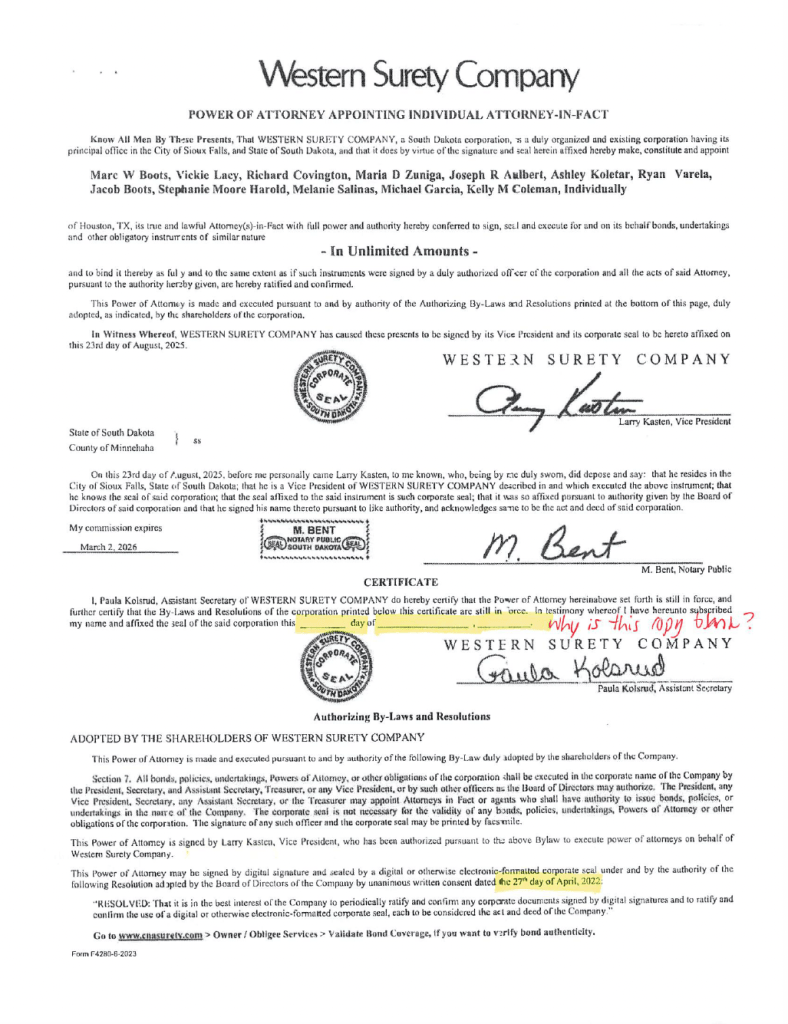
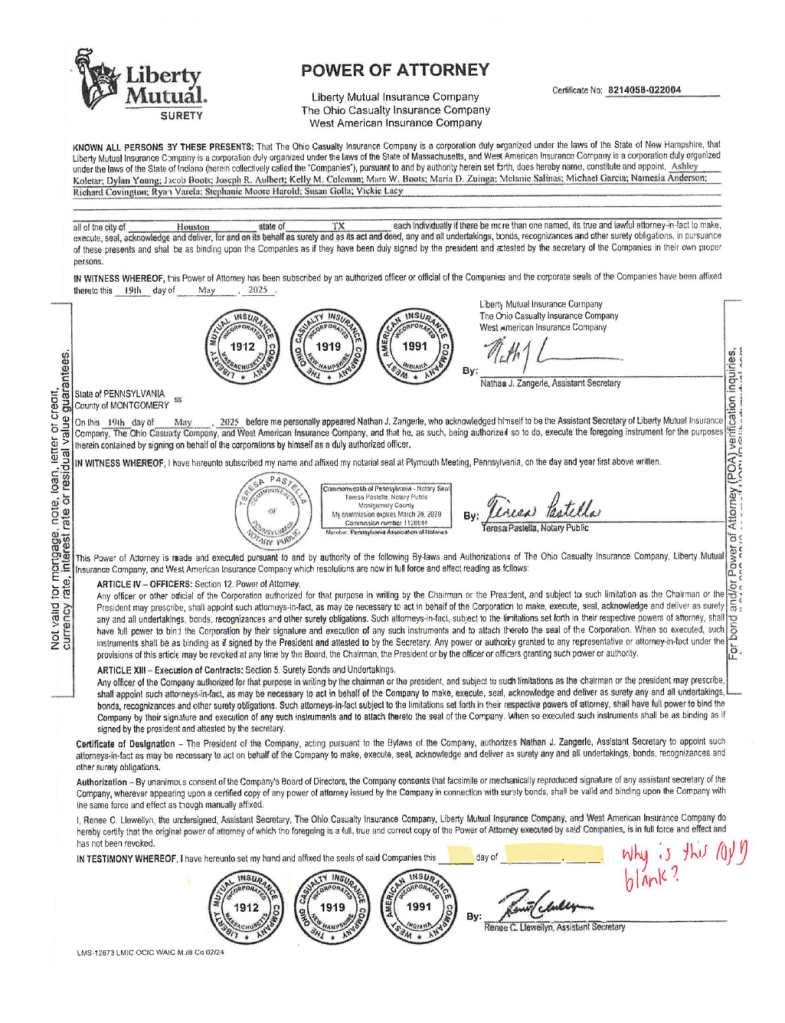
This bid indicates that Western Surety/Liberty Mutual Insurance Company provided the surety; however, I was provided two copies of these documents that present questions of their accuracy. The first document provided had no dates filled in by the signers with their digital signature; which indicates that digital signatures are allowed as of April 27, 2022. This means that a digital signature on a form doesn’t mean that each individual has to sign this document upon each instance; they could just reuse the same form if necessary. That also means that it could be copied and made to appear valid, even if it is not.
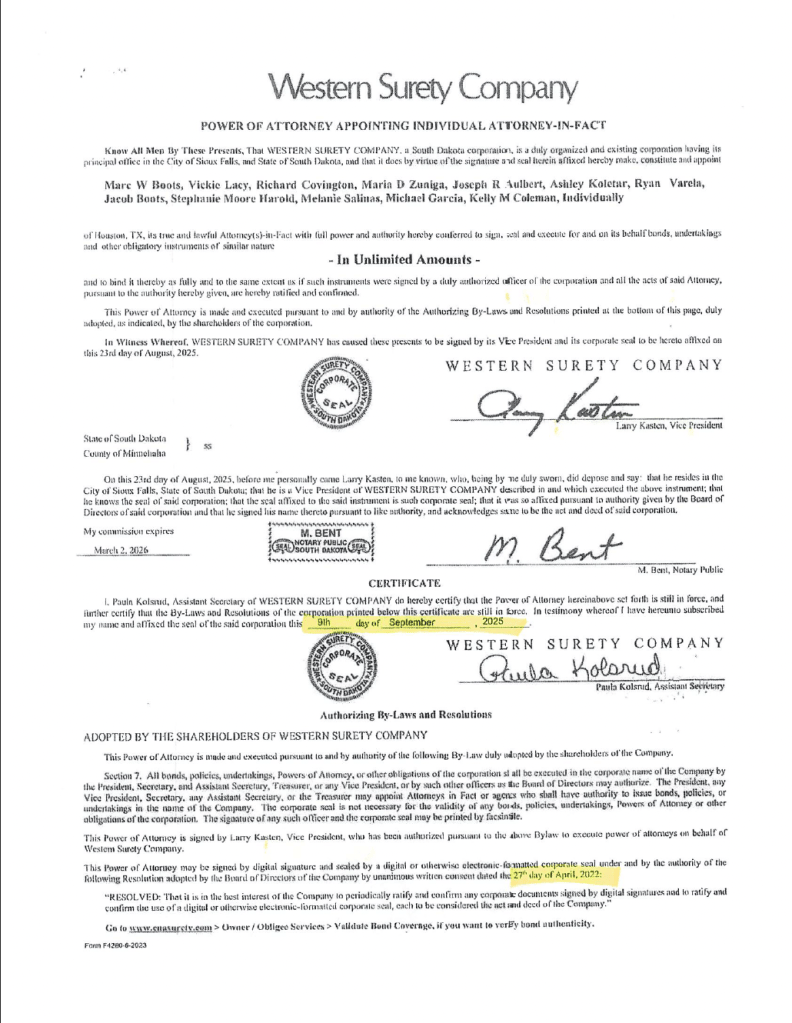
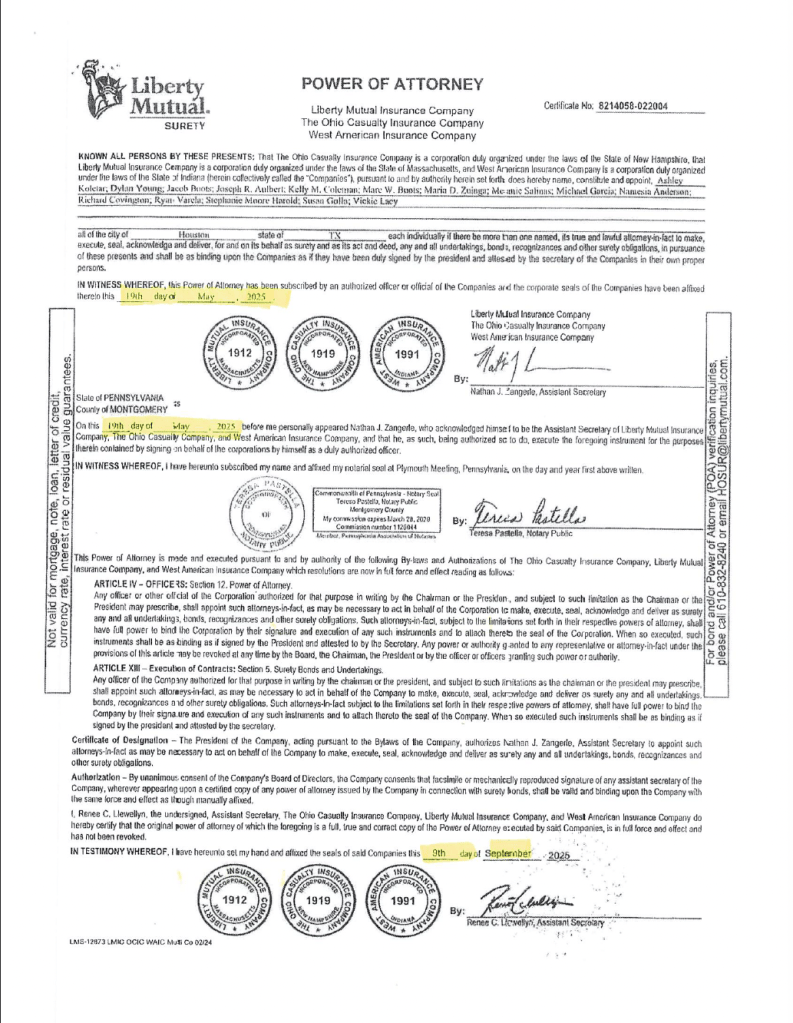
Here is the second set of surety documents, which are the same documents, only now they have a date provided in them which is May 19, 2025. How did The Scruggs Company know that they would need a surety bond for this project in May 2025, if it was presented in September of 2025, which was 4 months later? And why was it not signed by the parties required until September 9, 2025? Could these documents have been forged and fabricated?
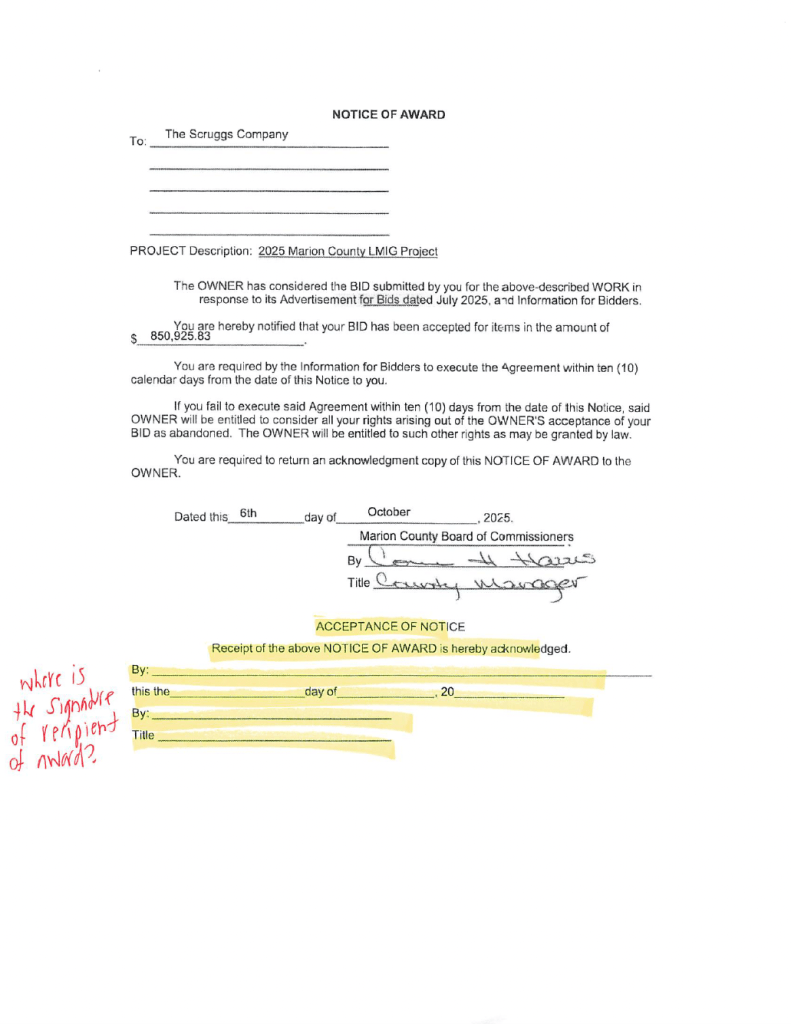
On October 6, 2025, The Scruggs Company was awarded the project, which was signed by Connie Harris, the Board of Commissioners’ County Manager; however, there is no signature by the recipient acknowledging the award.
An agreement was dated October 10, 2025, which was signed by Connie Harris, The Board of Commissioners’ County Manager, and by George Neal, a commissioner and chairman of the board, but there is no seal or signature from The Scruggs Company and Johnathan Mack on this documentation.
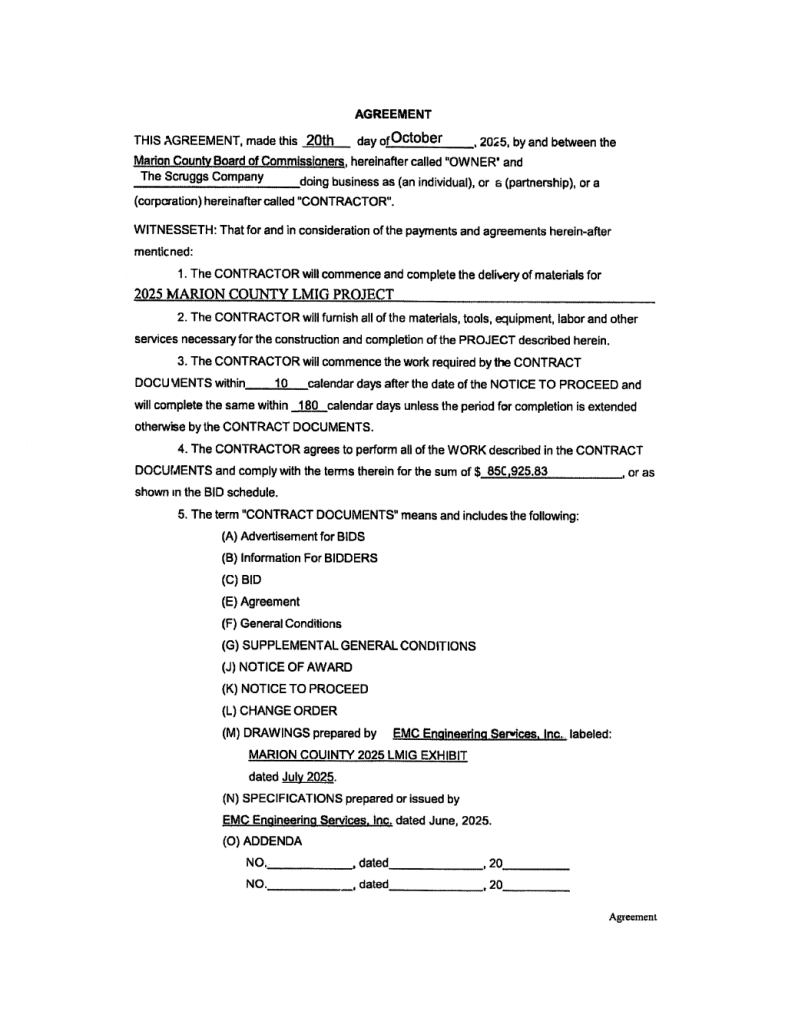
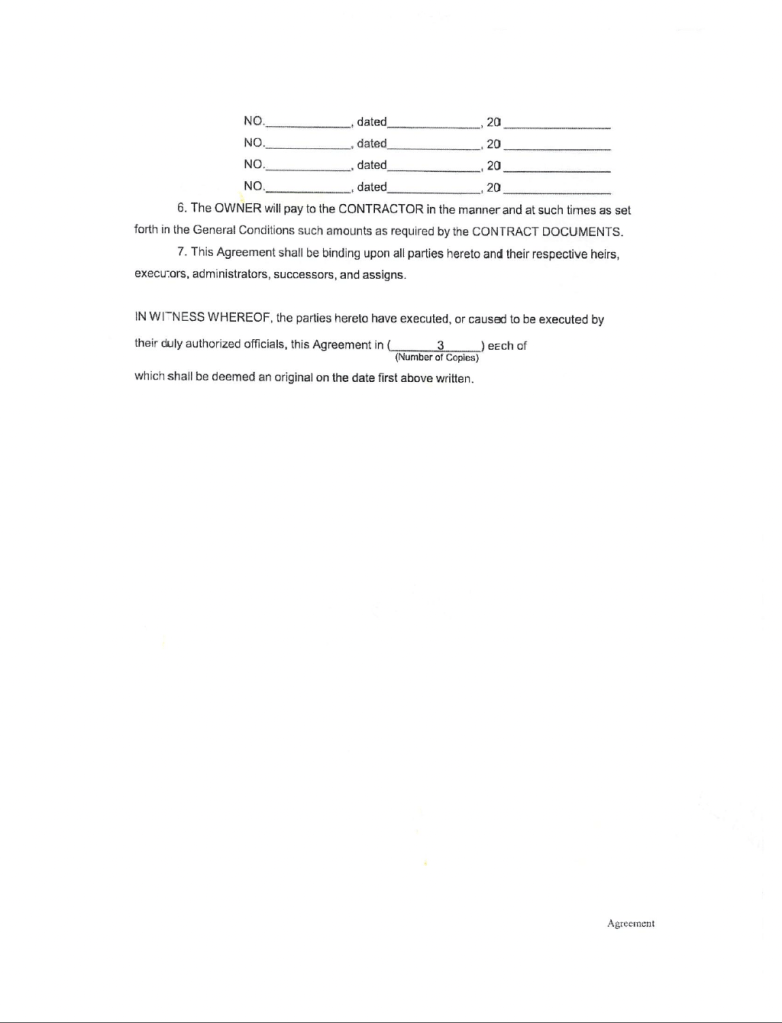
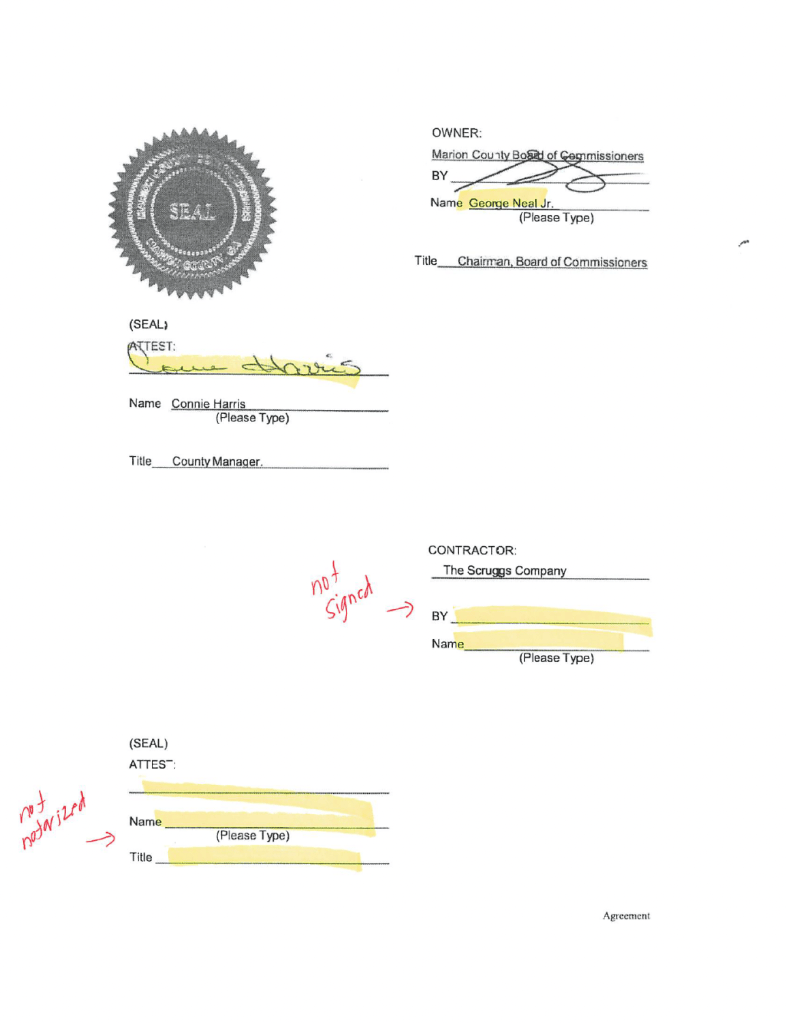
Were these documents ever actually sent and/or signed by The Scruggs Company?
Without signatures on both of these documents, if there were ever a case that was raised, there may be no legal recourse that either Marion County or The Scruggs Company could take. And with documents with no dates and then questionable dates, this adds to an even bigger problem with possible litigation. However, Georgia does have an exception for the Statute of Frauds, which indicates that Georgia requires a legal contract unless a party can prove part performance, which means that they delivered on their part of the contract, whether it was written and or signed, so it looks like either party might be saved if litigation were to occur.
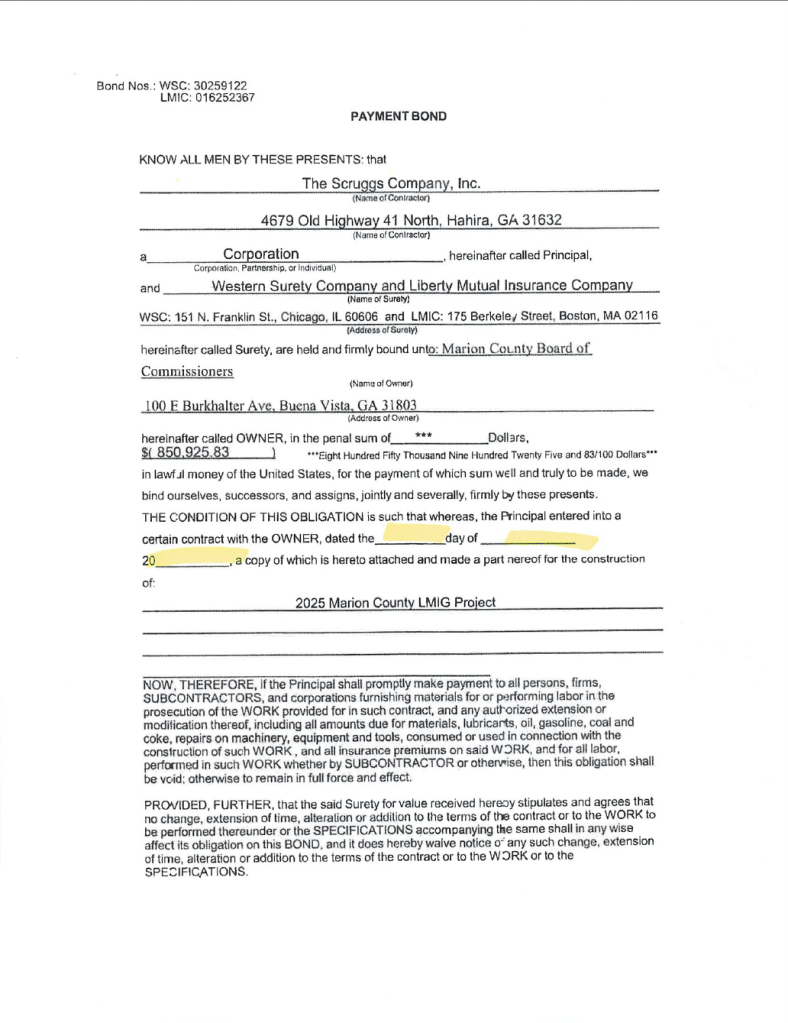
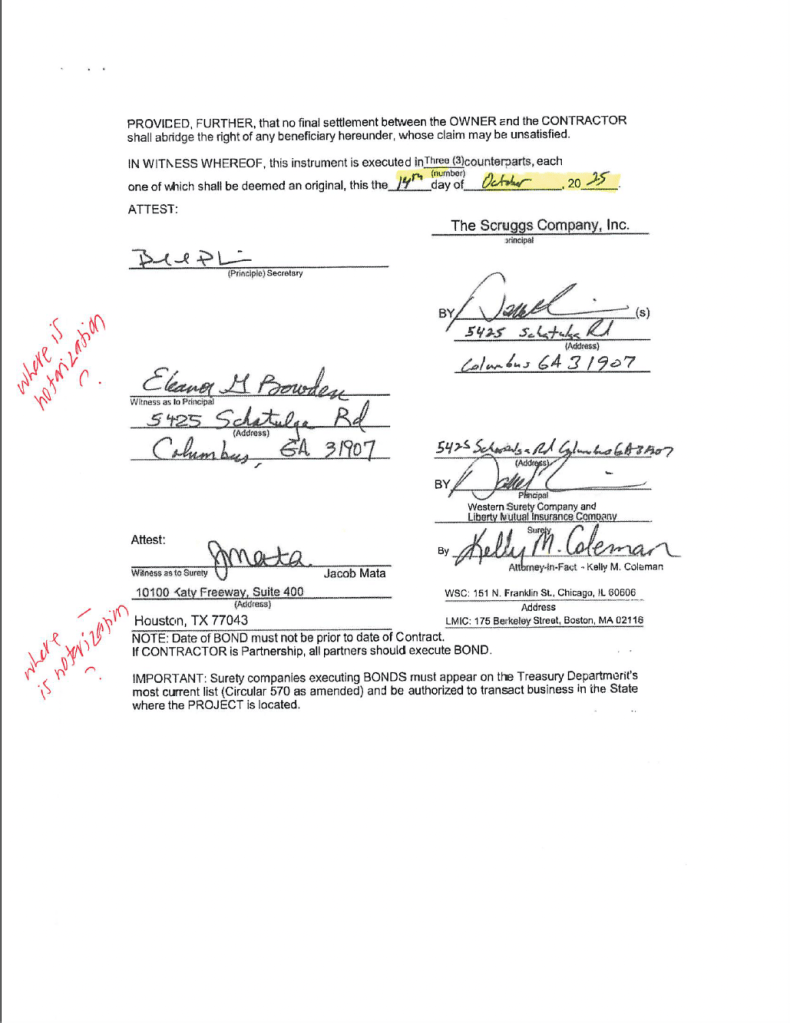
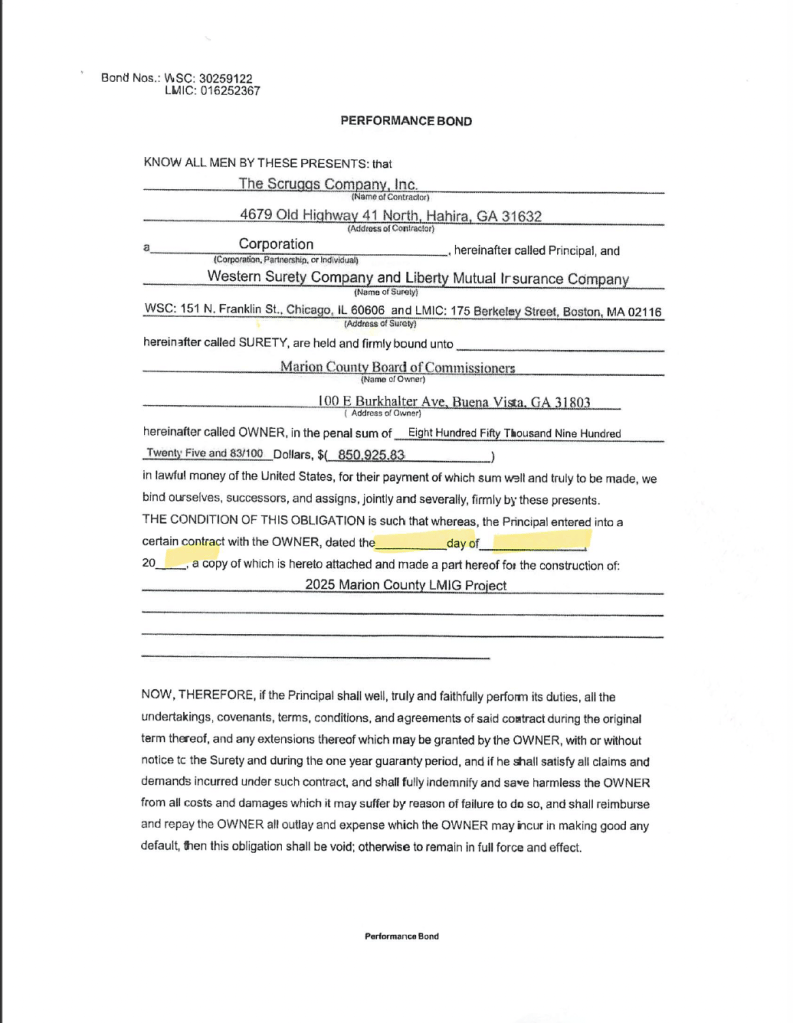
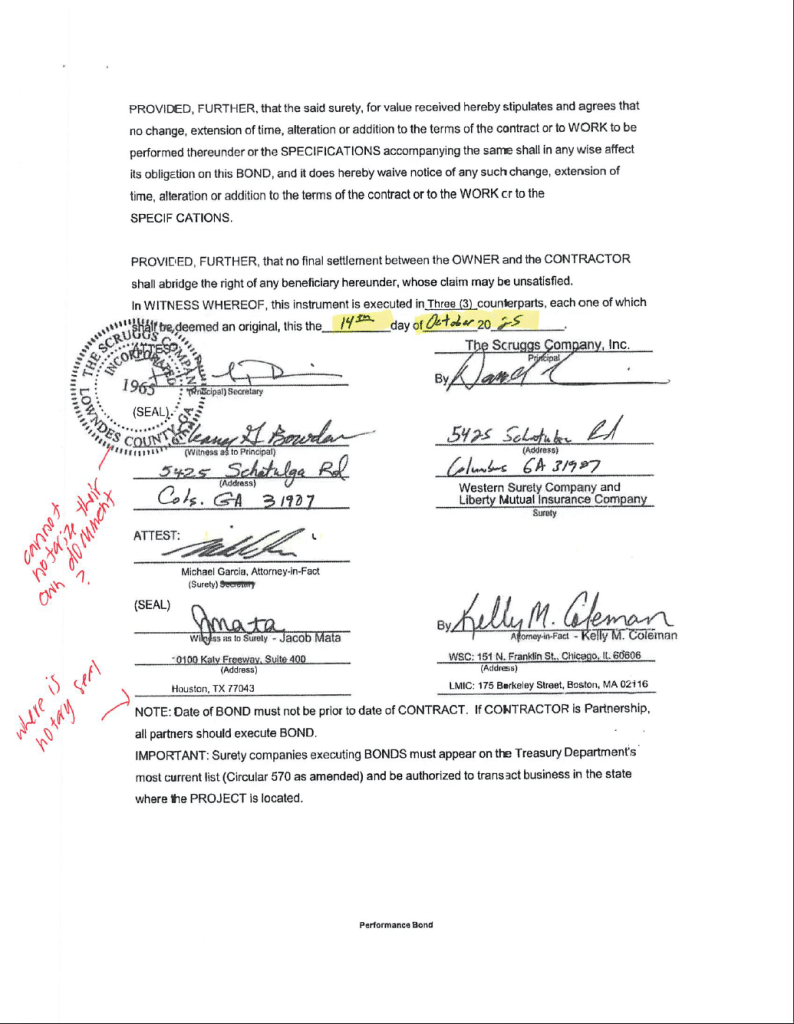
Upon being awarded the project, The Scruggs Company was required to provide a Payment Bond in the amount of $850,925.83 which is 100 percent of the cost of the base bid and they were required to provide a performance bond in the same amount, which is a 100% of the base bid requirement. Yet both documents have no dates entered for the principal entered into, but is signed by all parties of the surety and insurance company on October 14, 2025, and the seals for the Attorney-in-fact for Western Surety and the Witness to the Surety are not present on the Performance Bond and the seals for the Attorney in Fact and Witness for the Surety Company and The Scruggs Company are missing. So are these also fabricated and/or incomplete documents?
Payment Bond
Performance Bond
I went out to ensure that both Fouche Road and Harts Mill Road had been completed, and I can attest that I viewed both of them with my own eyes and they road smoothly. That being said, I believe that The Scruggs Company is entitled to the payment that they were approved to receive.
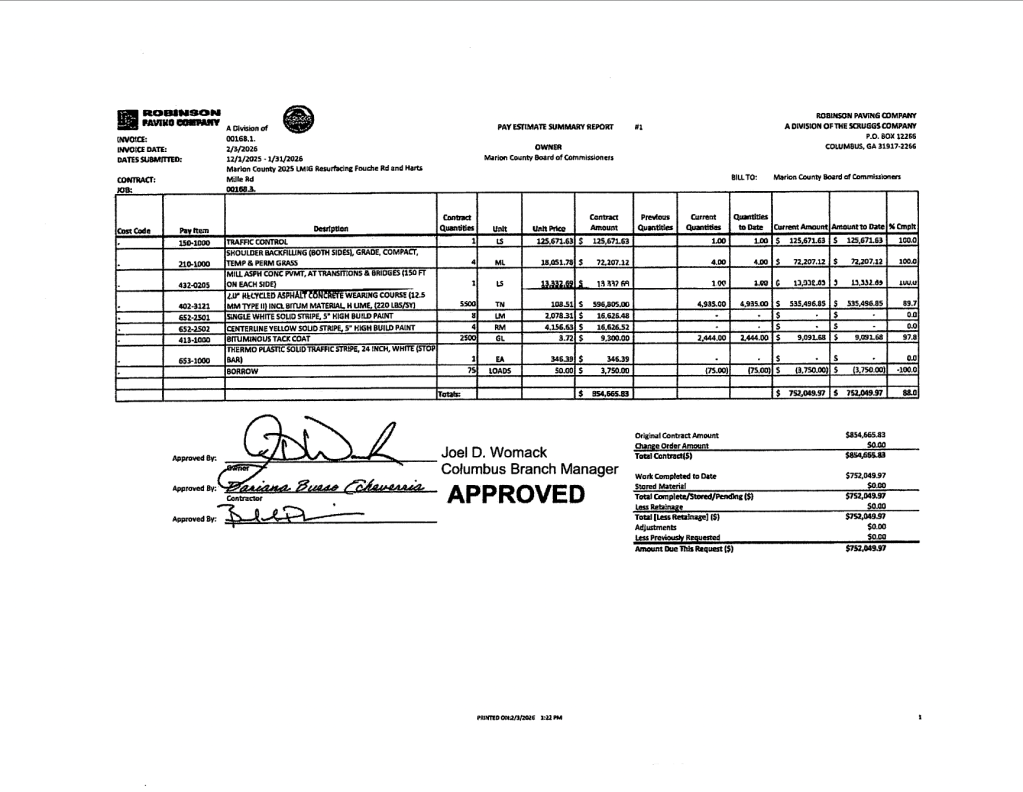
That being said, I received two invoices included in my open records request and I had some questions. The first invoice is dated 2/3/2026 and the amount that was due on that request was $752,049.97. The next invoice is dated 3/5/2026 indicates that the amount due is now $71,271.18. It’s not unheard of, but this means that in one month, the county paid $680,778.79 to Robinson Paving Company (not The Scruggs Company), and the balance was 71,271.18. That means that they had not entirely paid the full amount requested by the due date and i do not see any late fees or interest charged. That also means that there was $102,615.86 of work that had been uncompleted and according to the contract, it would have had to be completed by April 8, 2026, which according to my personal verification, all work is complete
2/3/2026 Invoice 1
3/5/2026 Invoice 2
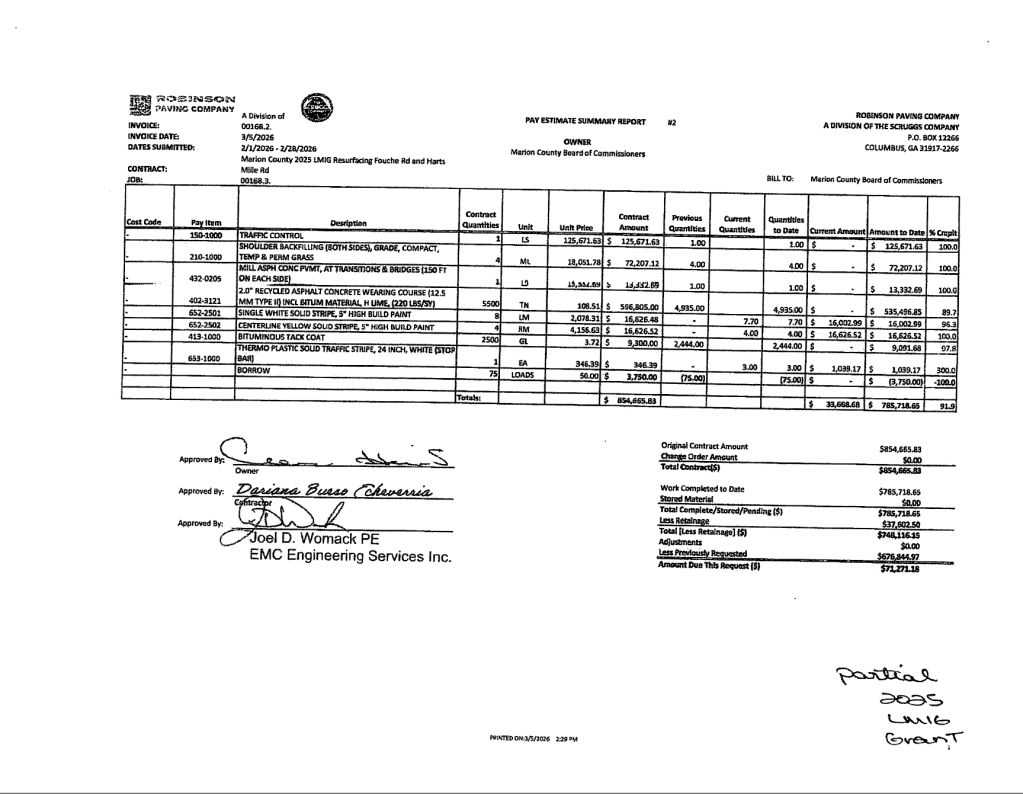
What doesn’t make sense to me, is why Invoice 2 has Connie’s signature in the Owner’s field, which is Joel D. Womack on Invoice 2. Does this mean that Connie Harris owns Robinson Paving Company too? Why does Invoice 2 not say approved on it, like Invoice 1? And why does it say partial 2025 LMIG grant, when we have already proven hands down, that Marion County had no LMIG grant money since 2023? I also thought it was interesting that Joel D. Womack is listed as the branch manager of Robinson Paving Company as evidenced in Invoice 1 and he is also the representative of EMC Engineering Services, Inc., who was responsible for preparing the project documents in July 2025. Would this be considered a conflict of interest?
Additionally, why are these invoices from Robinson Paving Company if The Scruggs Company is who the contract was with. There is nothing on these bid documents that says Robinson Paving Company; therefore, shouldn’t the invoices come from The Scruggs Company?
What I found further questionable is that Connie made a note on the copy of the check receipt that said this was the final payment for Harts Mill Road and Fouche Road for phase II of the project. This documentation indicates that check 1023 was created on March 5, 2026 in the amount of $71,271.18 to be paid to Robinson Paving Co (not The Scruggs Company), whereby the description of payment is indicated as Roads-Capital Outlay-Infrastructure. Why also is there no date of approval on the stamp on this item to be paid? Whose signatures are under the Commissioners and why is George Neal’s signature missing from the Chairman’s field, since three commissioners are required to approve all payments, resolutions, personnel, and legislation?
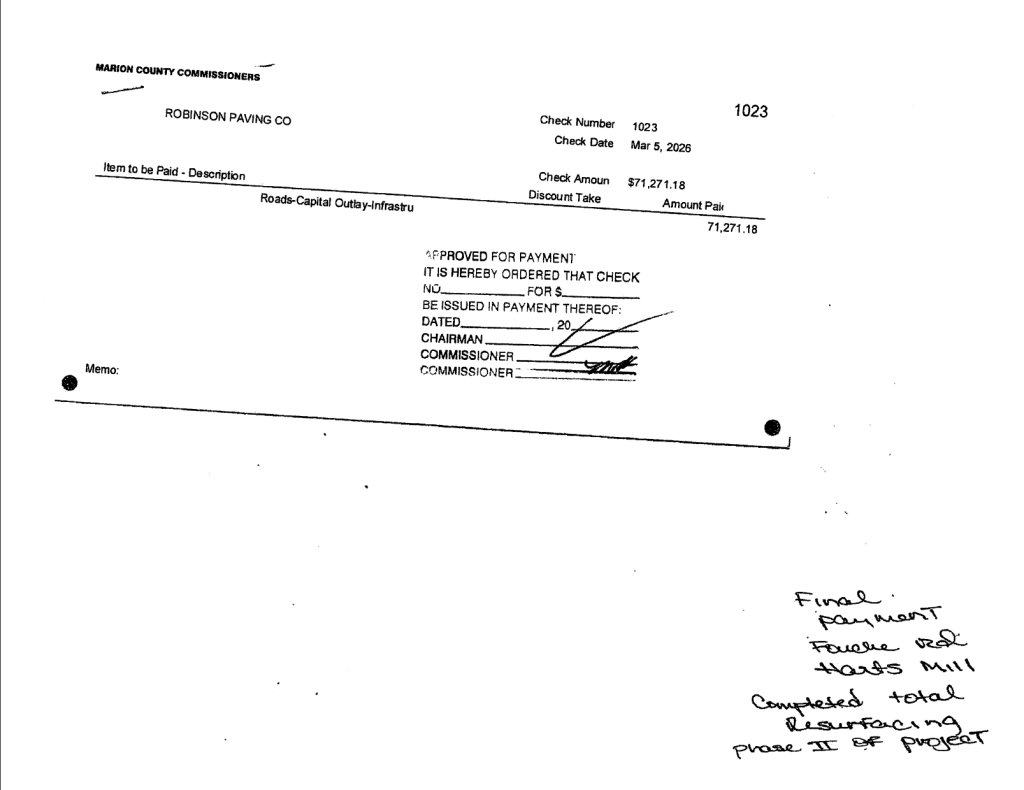
Since there was $102,615.86 of work that had been uncompleted as of March 5, 2026, does this mean that there was still documentation and invoices left to pay that were not included with the open records request I am entitled to? Why would it say that this was the final payment? Was there a phase III? If so, when was it finished and why was it not included with this information as a requirement of my open records request performed July 18, 2026? Since the 180 calendar days would have already expired, the uncompleted work should have been invoiced and paid, or included. There is also nothing in the bid that indicated that this work would be done in phases at all, which should have been outlined.
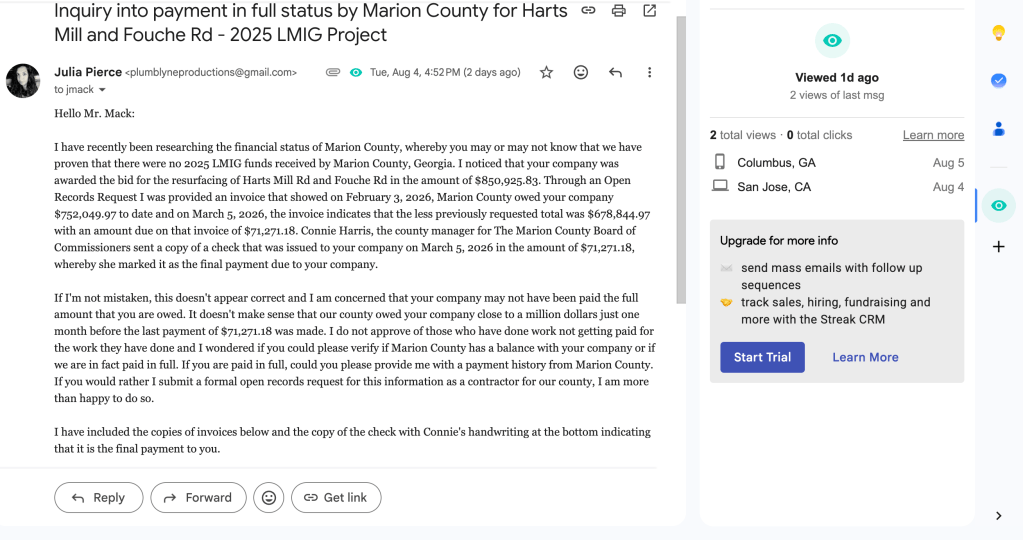
I wrote an email to Johnathan Mack and requested clarification on whether or not this project has been paid in full by Marion County, and why the payment receipt indicated that it was the final payment? I also asked if there was a payment of $680,778.79 made from the first invoice to the second invoice. I have not received any response, but I do see where he initially read it and one other viewer read it as well, which could have been him also reading it from his phone in Columbus after initially reading it from his laptop/PC.
I have a couple more questions? Why was the bid for $850,915.83, but approved for $850,925.83 when it was never requested or itemized as $850,915.83?
Why was the completed total by Robinson Paving Company listed as $854,665.83, when they were approved for $850,925.83? Where did the other $3,740 come from and where is the approval for that? We have already covered all the approvals in the previous publication linked at the very top of this page in the first paragraph.
Was all of this documentation provided after the fact because I requested it or because the county found out I was questioning its completion?
What do you think?
If you have a story, feedback, or questions, please feel free to contact me at Plumblyne Productions by email at plumblyneproductions@gmail.com or call me at 229-329-2179. Don’t forget to subscribe, share, and follow to stay up to date.


Leave a Reply