
Julia Pierce | July 1, 2026
In the previous post, I summarized the anomalies I found in analyzing the time punch cards provided by the County Manager’s Clerk, Heather Wright, along with the pay stubs she also provided to me. Below is a recap of the anomalies I observed on the pay period.
Anomalies Observed
March 1 – March 14
- Certain employees were overpaid by cumulative total of $39.92.
- Certain employees were shorted a cumulative total of $518.59.
Anomalies by Employee
Anthony Allen
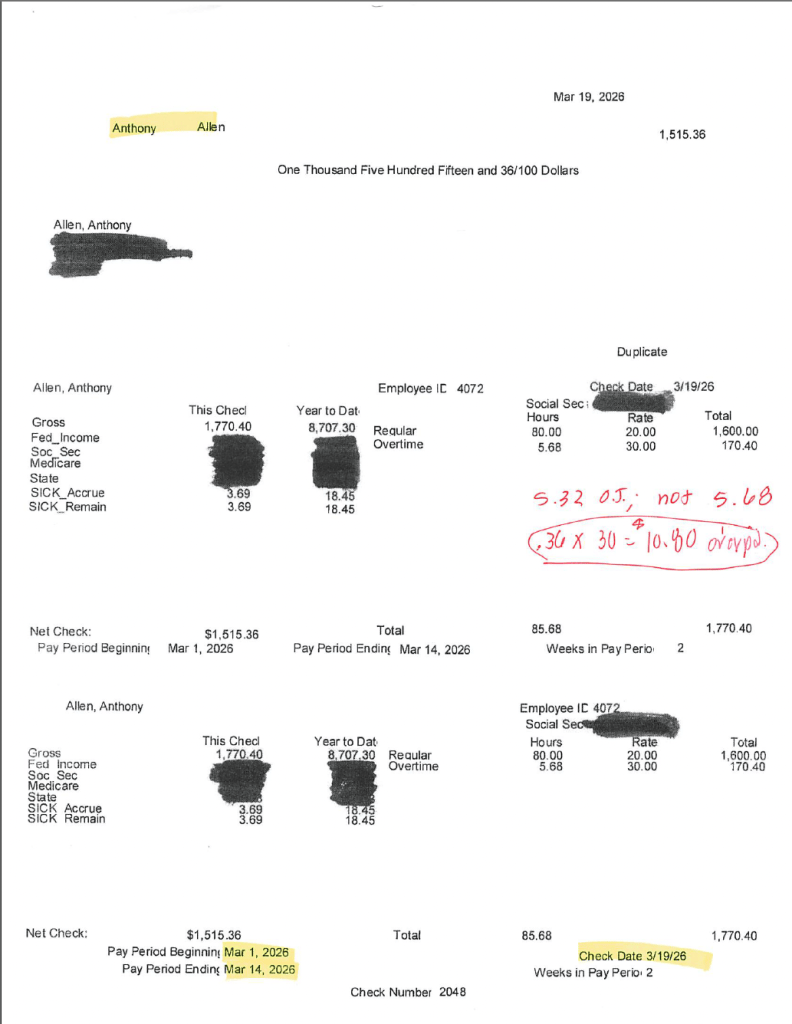
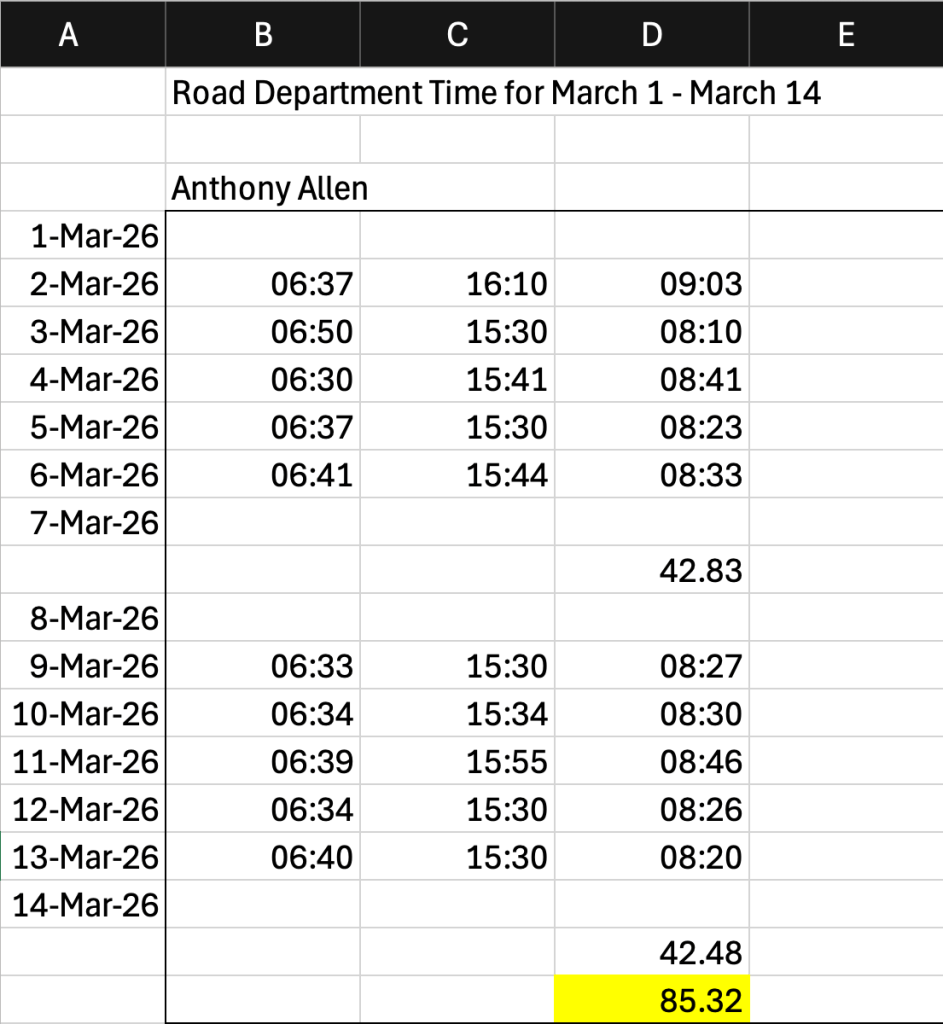
When I added the time punches into Excel, subtracted the clock in time from the clock out time for each day, where I included the formula to auto deduct the thirty minutes for lunch that Heather Wright indicated was required, and then added all the time for each week, I was able to identify that Anthony worked 85.32 hours for both weeks. That means that he made 5.32 hours of overtime (OT) that week, but his pay stub indicates that he was paid for 5.68 hours.
In the pay stub image below you can see that I multiplied the .36 hours, which is the difference in what the county said he worked and what Anthony said he worked, by his OT rate of $30.00, which indicates that he was overpaid by $10.80 for this pay period.
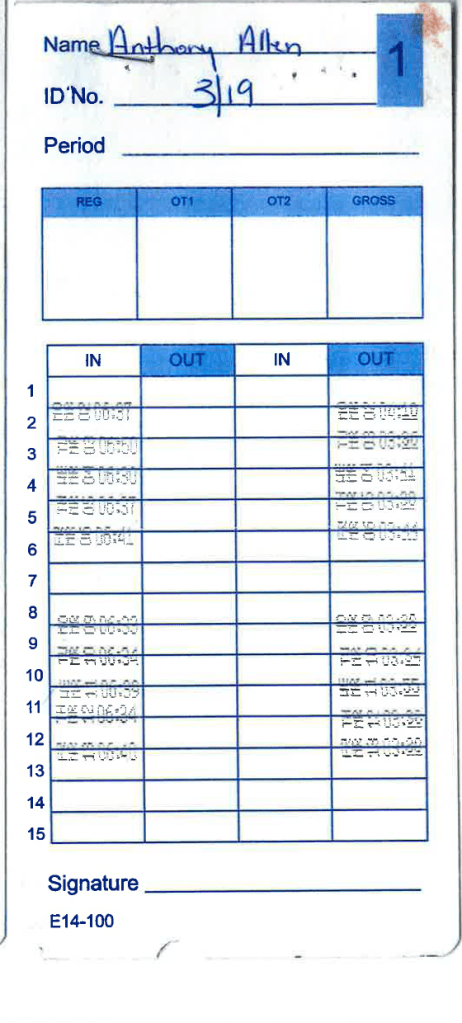
The formula I used to calculate the daily time worked and subtract the 30 minute lunch period is =SUM(C5-B5) – TIME(0,30,0).
To calculate the weekly total, I used the following formula: =SUM(D5:D9)*24. This calculates the time worked from [h]:mm, and multiplying it by 24 changes it to the hours in decimal format. I did this for both weeks to get the total hours worked for each week and then added the hours in the cells with the hourly totals together to get the total hours worked for the pay period.
Johnathan Allen
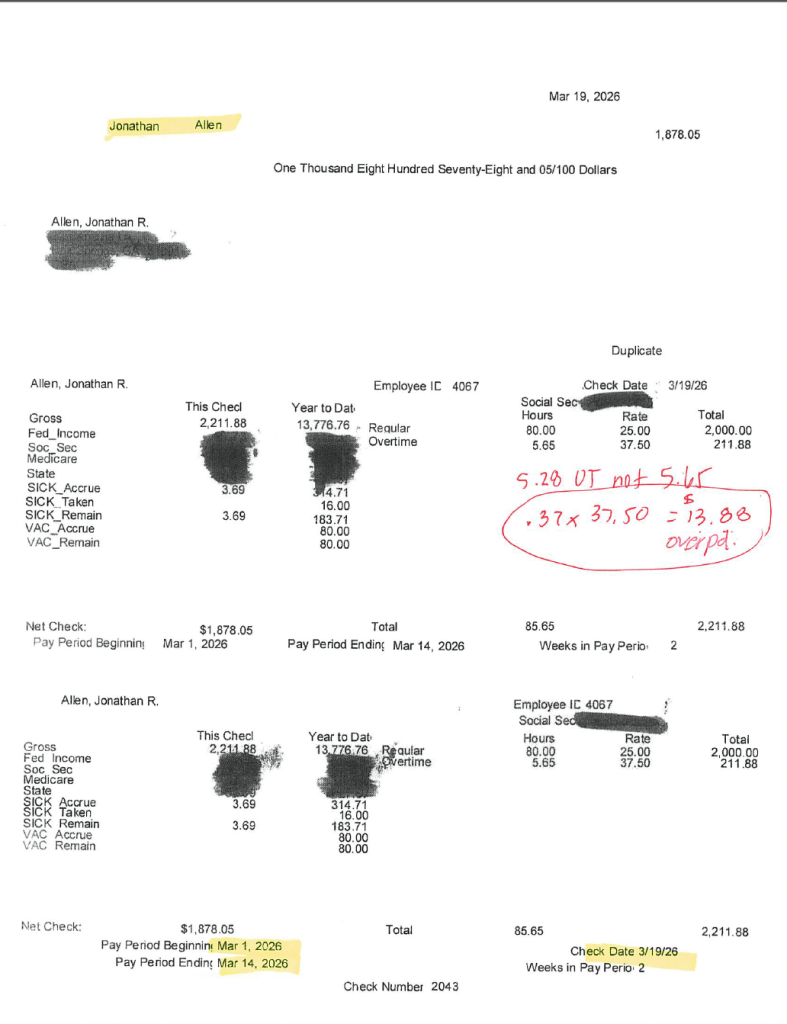
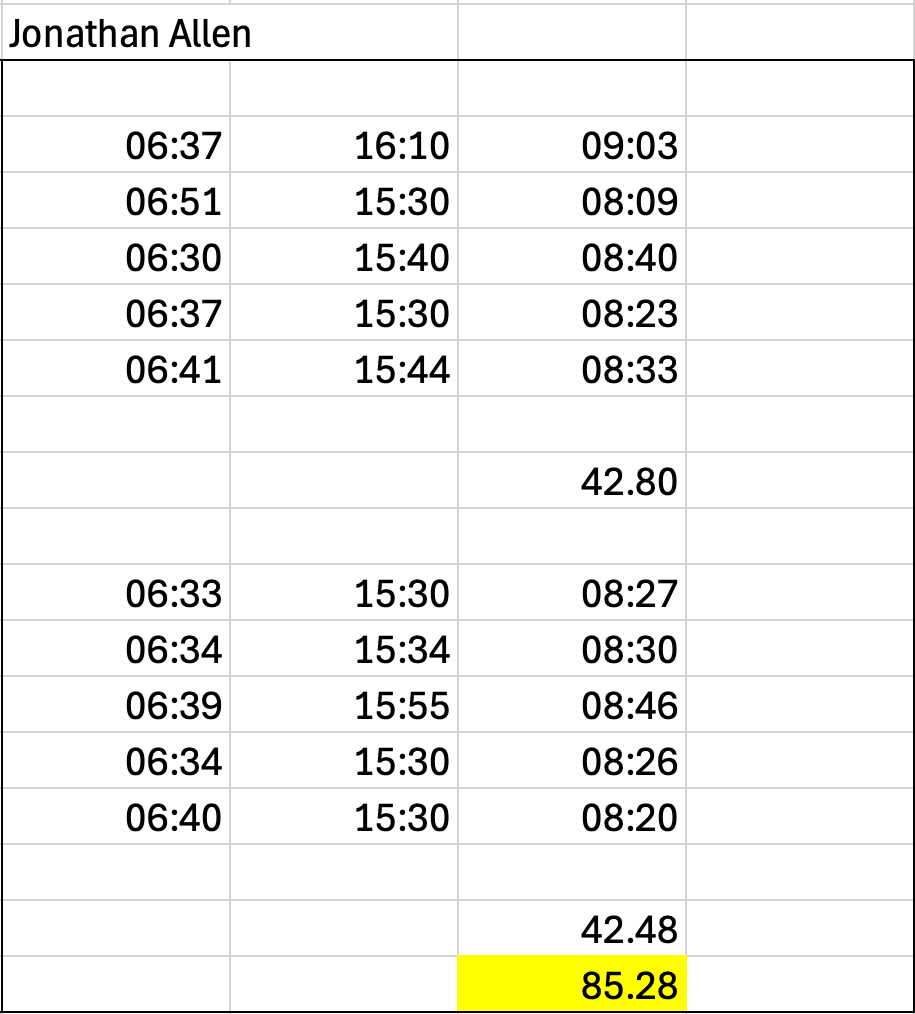
Johnathan worked a total of 85.28 hours, which means that he worked 5.28 hours OT. On his pay stub, the county logged that he worked 5.65 hours OT, which is .37 hours OT that Johnathan was overpaid.
In the pay stub image below you can see that I multiplied the .37 hours by his OT rate of $37.50, which indicates that he was overpaid by $13.88 for this pay period.
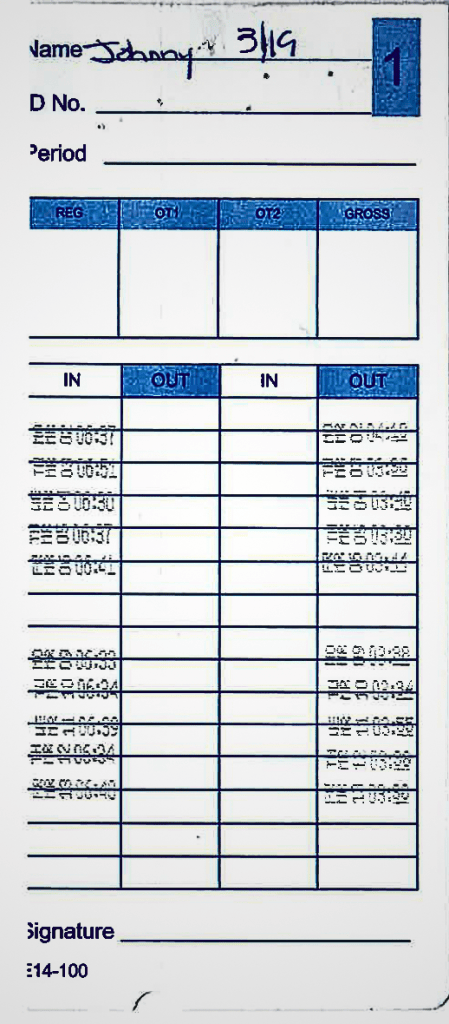
I used the same calculations as above with the specific punch in and out times, weekly, and bi-weekly totals for Johnathan Allen.
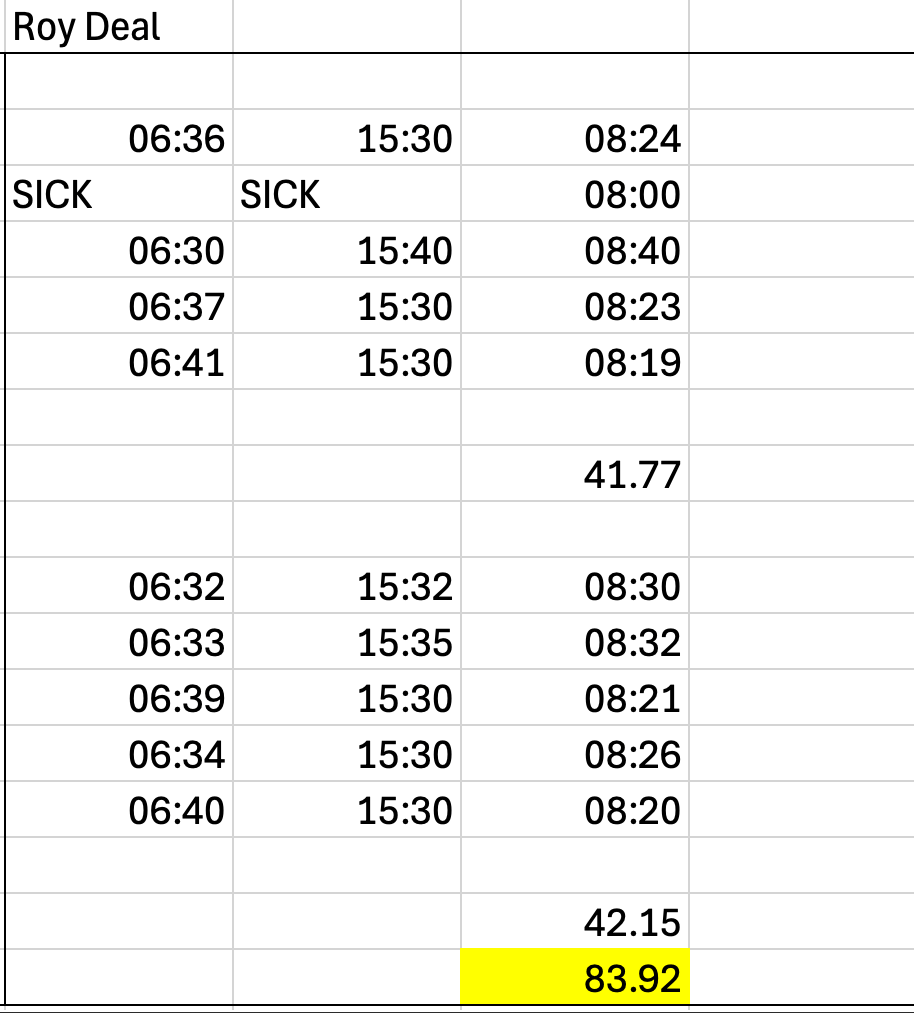
Roy Deal
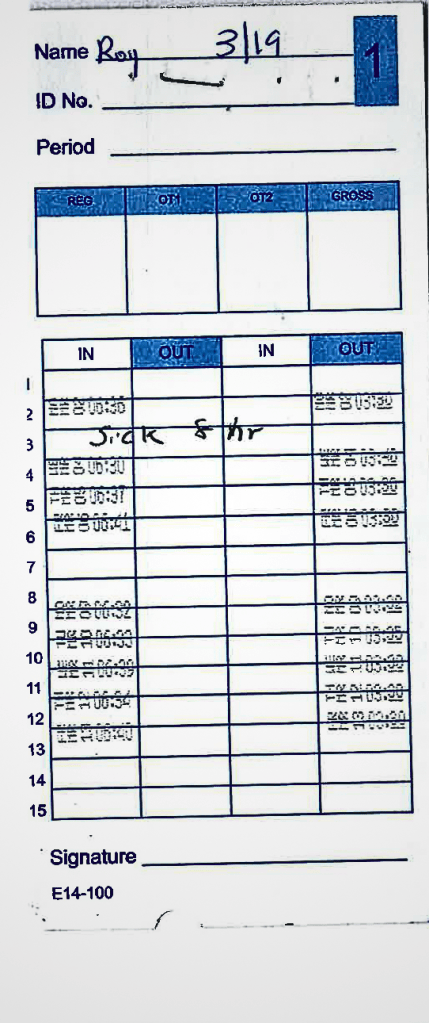
Because Roy took sick time during his first week during this pay period, he was not paid for his OT. Roy was, however, shorted for the hours of OT on his second week of pay during the pay period. After calculating his hours per his time punch entries, Roy should have been paid for 2.15 hours; not the 2.14 hours the county paid to him. If we multiply the .01 difference by his OT rate of $39.00, we get $0.39. This means he was shorted by $0.39.
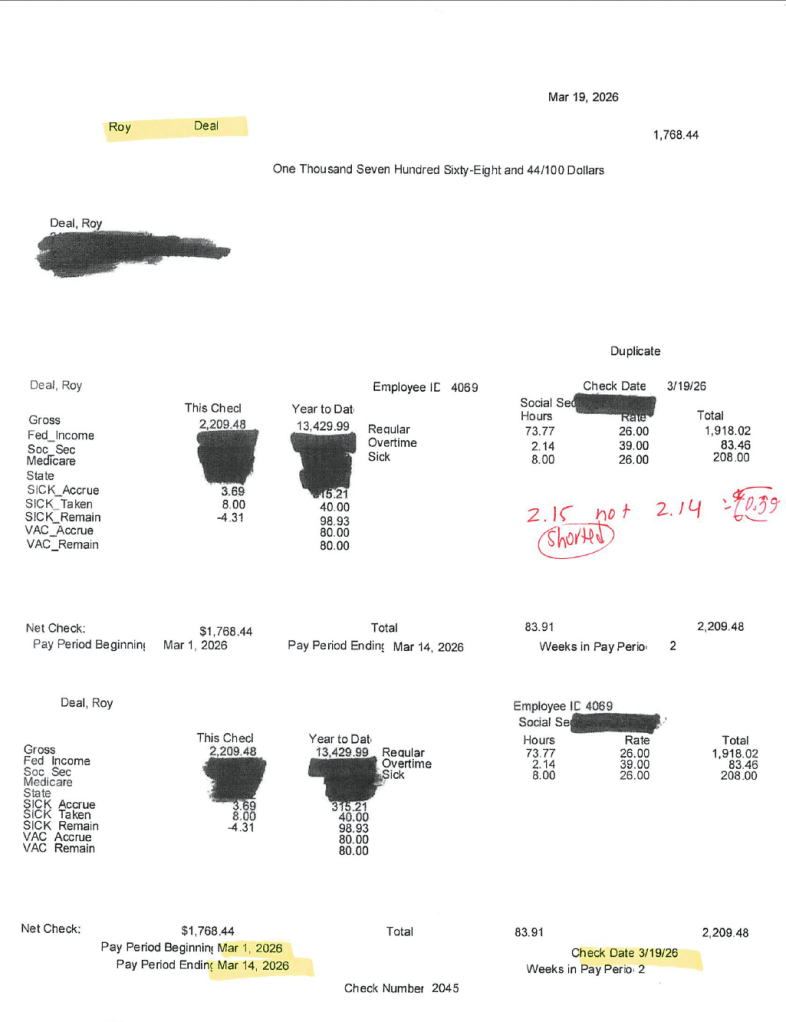
I know that’s only $0.39, but it’s still shorting an employee the wages they are due.
I used the same calculations as above with the specific punch in and out times, weekly, and bi-weekly totals for Roy Deal.
Jeremiah Johnson
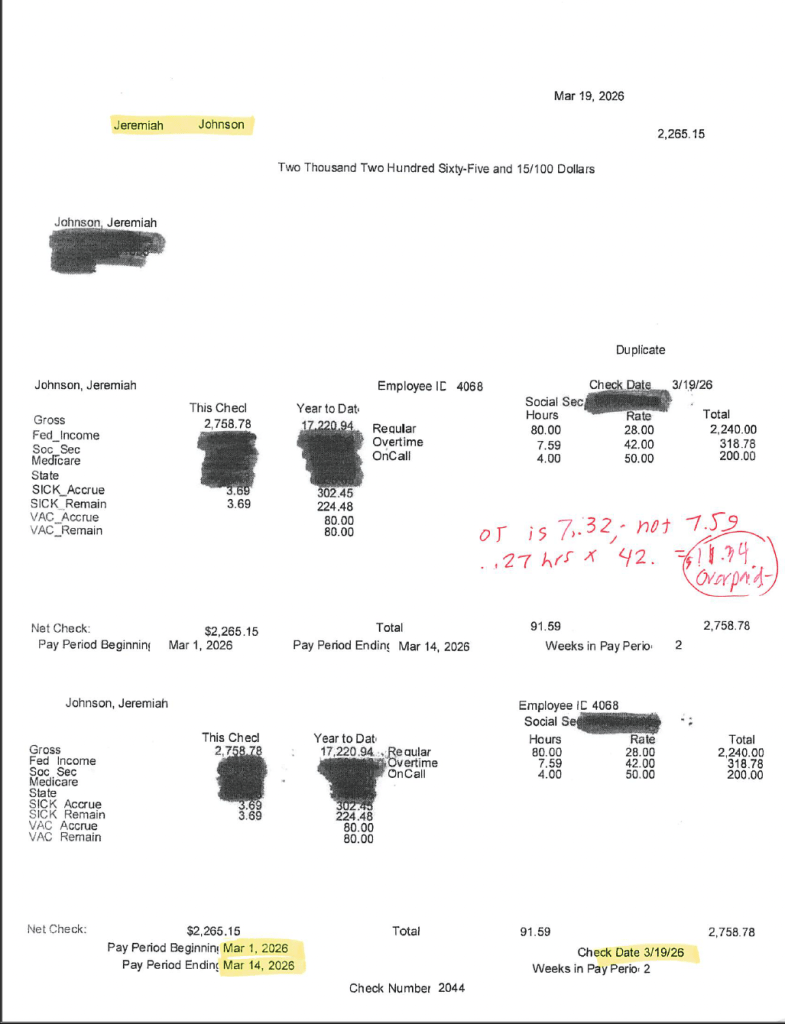
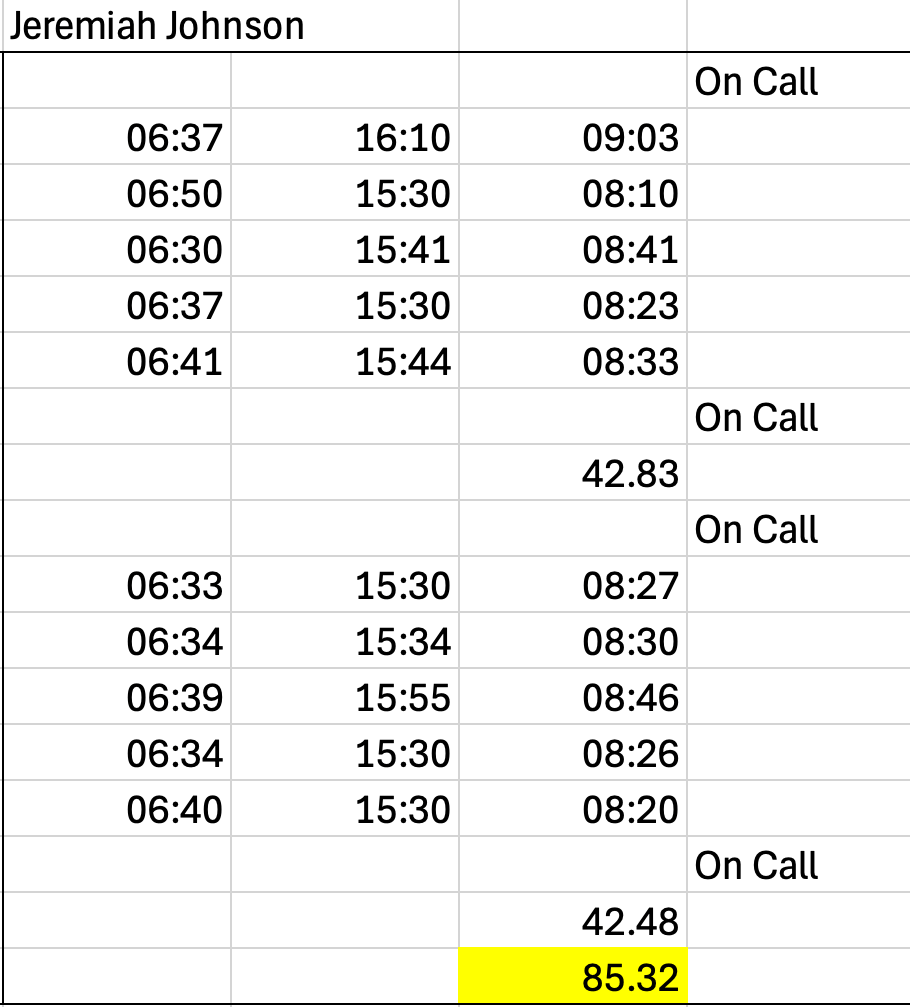
Jeremiah Johnson worked a total of 85.32 hours that was logged on his time card. Notice that his pay stub says that he worked 7.59 hours of OT; not 5.32 hours of OT. This is because Jeremiah was called out and he worked for 2 hours during that on-call project, and you see that note on his time punch card that says he had a 2hr call out.
You also see that he was paid for 4 hours of on-call time. According to Heather Wright, each road employee is paid a $50 per day stipend to be on call, because they have to be available all day in the event work calls. Jeremiah was on-call both weekends which is why we see he was paid $200.00 for being on-call. $50 per day times 4 days is $200.00.
The only problem with the pay Jeremiah received is that his OT is 7.32 hours and the county paid him for .27 more hours than he worked. 5.32 hours plus the 2 hours for the call out is 7.32 hours; not 7.59 hours. I calculated the difference of .27 hours and multiplied it by the OT rate Jeremiah is paid. The total that the county overpaid him is $11.34.
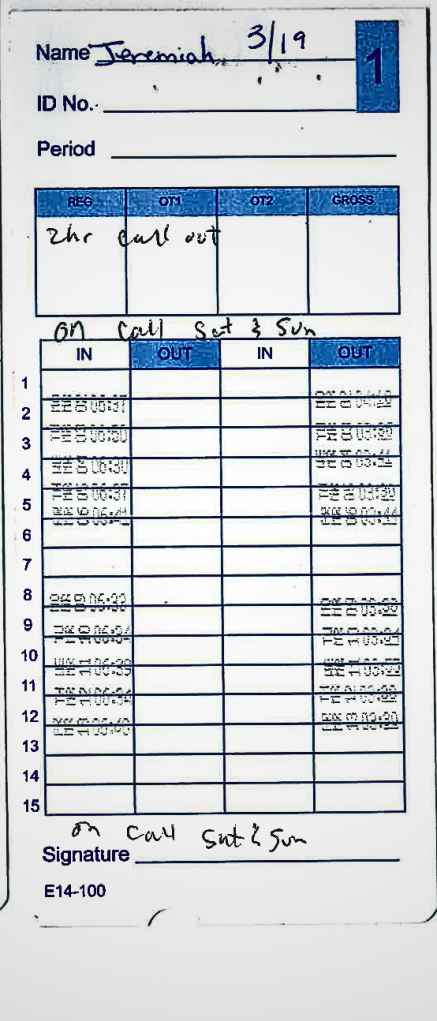
I used the same calculations as above with the specific punch in and out times, weekly, and bi-weekly totals for Jeremiah Johnson.
Eric O’Neal
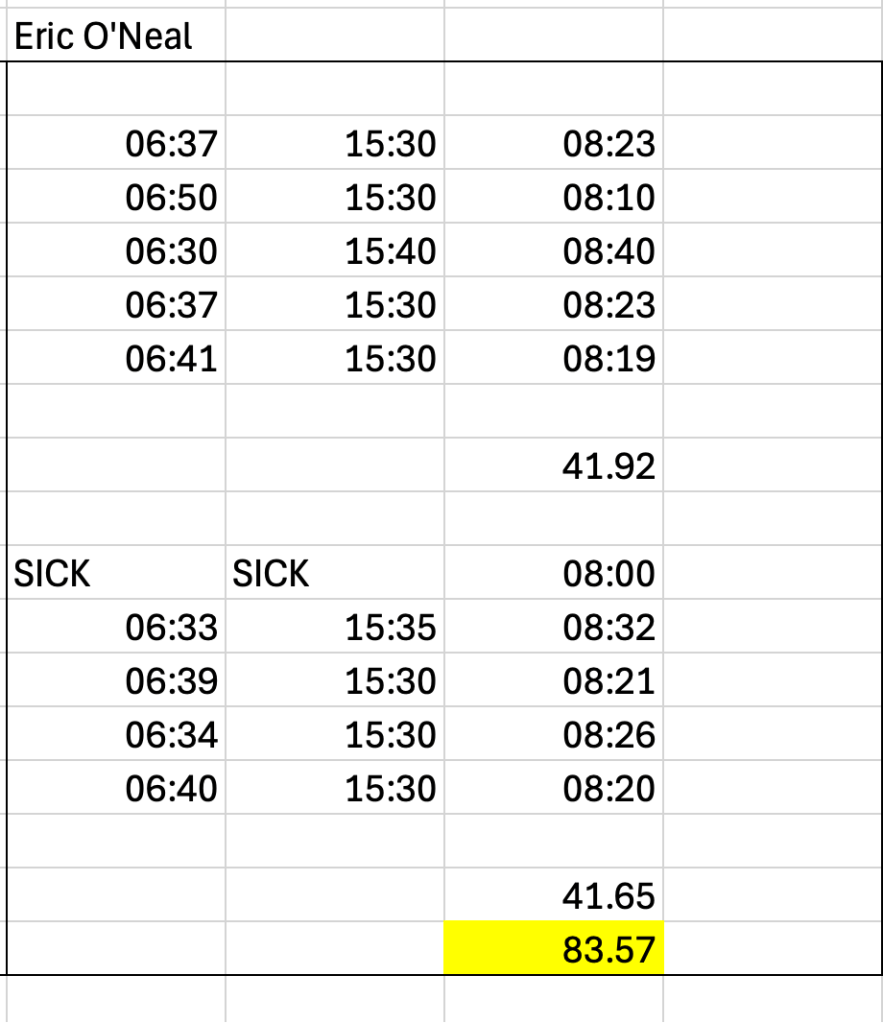
Eric was both overpaid on his OT and shorted on his regular hours. According to his time card, he worked a total of 41.92 hours of his first week of the pay period, which entitles him to 1.92 hours of OT. The county paid him for 2.02 hours of OT which is $3.90.
He logged sick hours during his second week of the pay period, which means that the 41.65 hours he worked would be calculated at his regular pay of 26.00. If we add the 40 hours of regular time for the first week to the 33.65 hours of regular time from the second week, we get 73.65. The county calculated him as having worked 73.64 hours, which shorted him .01 hours. That equals $0.26 he was shorted.
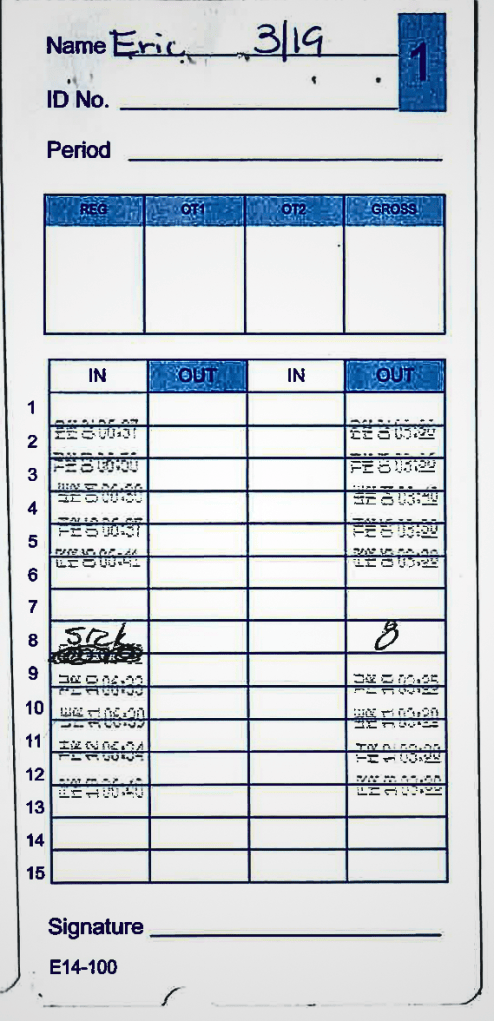
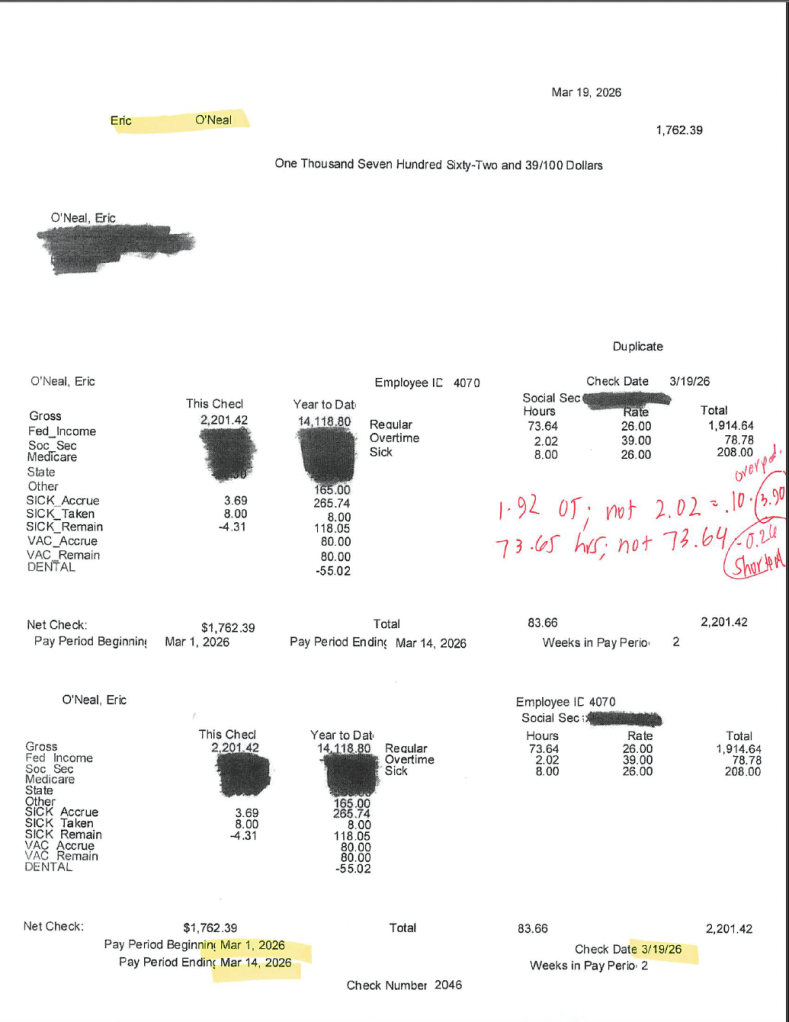
Again, I used the same calculations as above with the specific punch in and out times, weekly, and bi-weekly totals for Eric O’Neal.
Anthony Tyler
And here is where the biggest problem is presented. Anthony was shorted $502.50 for 13.40 hours of OT he worked, which is 13.40 hours at a rate of $37.50.
He was paid accurately for the amount of regular hours and for his on-call stipend for 4 days, but where is his overtime? How could the county personnel responsible for inputting Anthony’s time miss all of his OT?
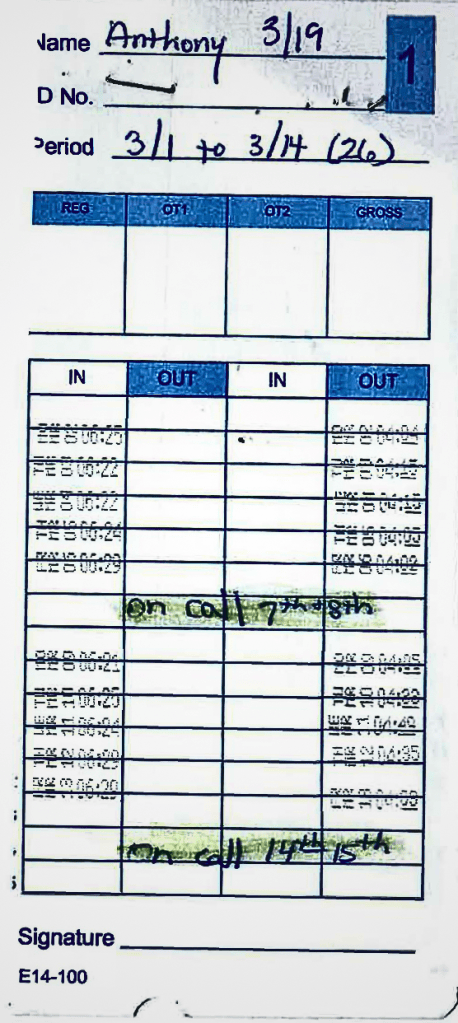
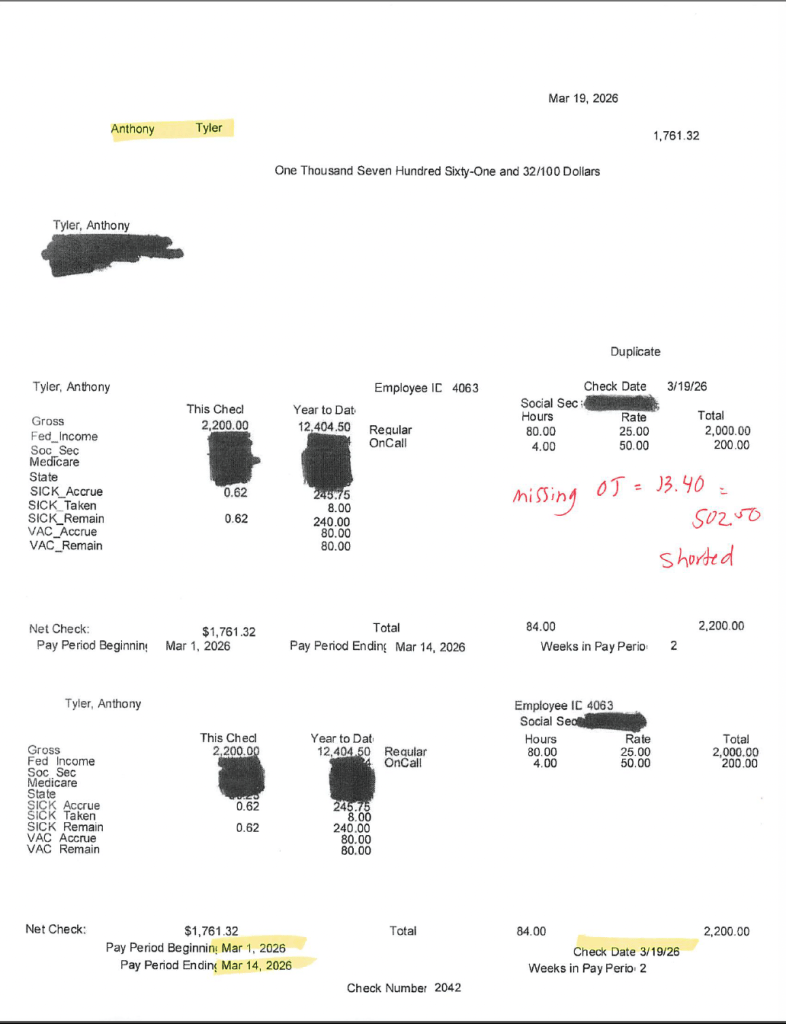
I used the same calculations as above with the specific punch in and out times, weekly, and bi-weekly totals for Anthony Tyler.
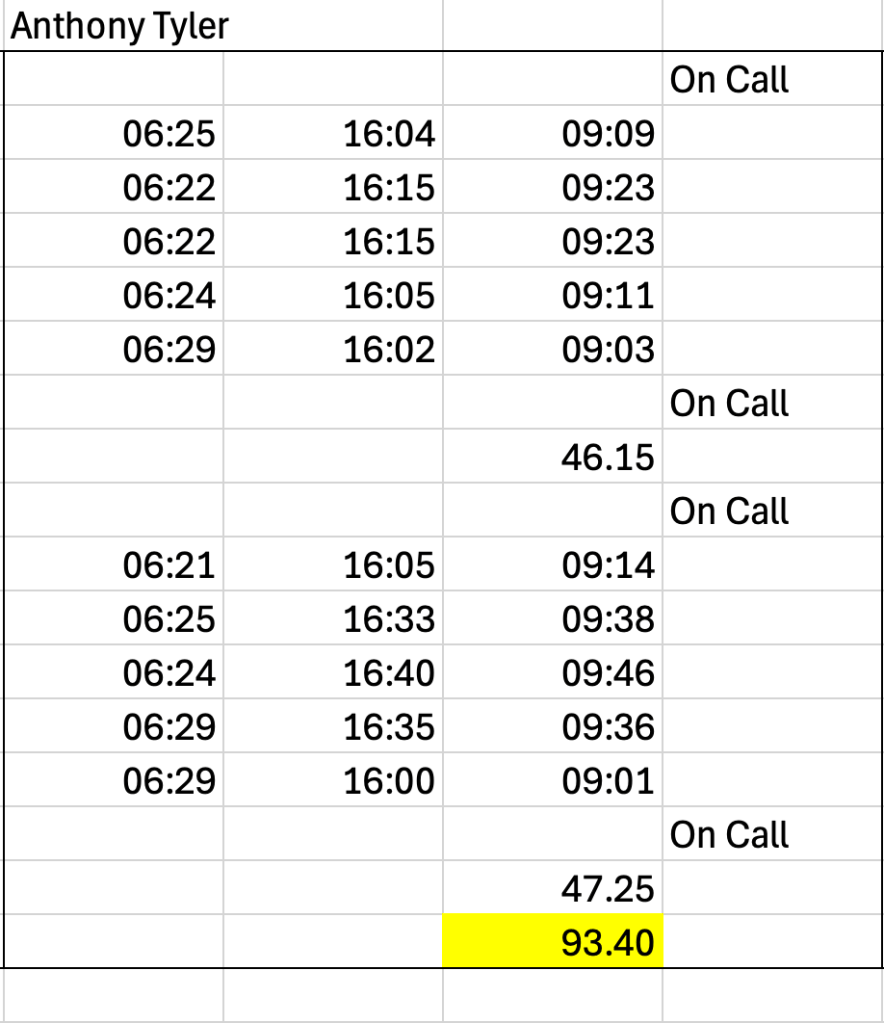
Ronald White
Ronald White was shorted a total of $15.44. He was shorted $0.24 for OT and shorted $15.20 for regular hours worked.
Ronald worked a total of 44.07 hours in the first week of the pay period, which is 4.07 hours of OT. The county paid him for 4.06 hours.
Ronald worked a total of 43.73 hours, of which 16 hours were sick hours, which means that he should have been paid the 40 hours from the first week and 27.73 hours from the second week. This is 67.73. The county only paid him for 66.78 hours. That’s a difference of .95 hours.
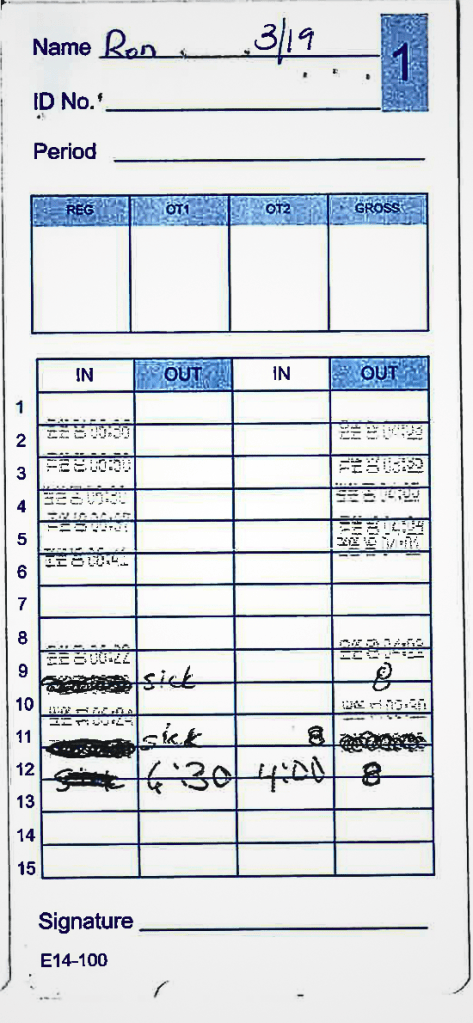
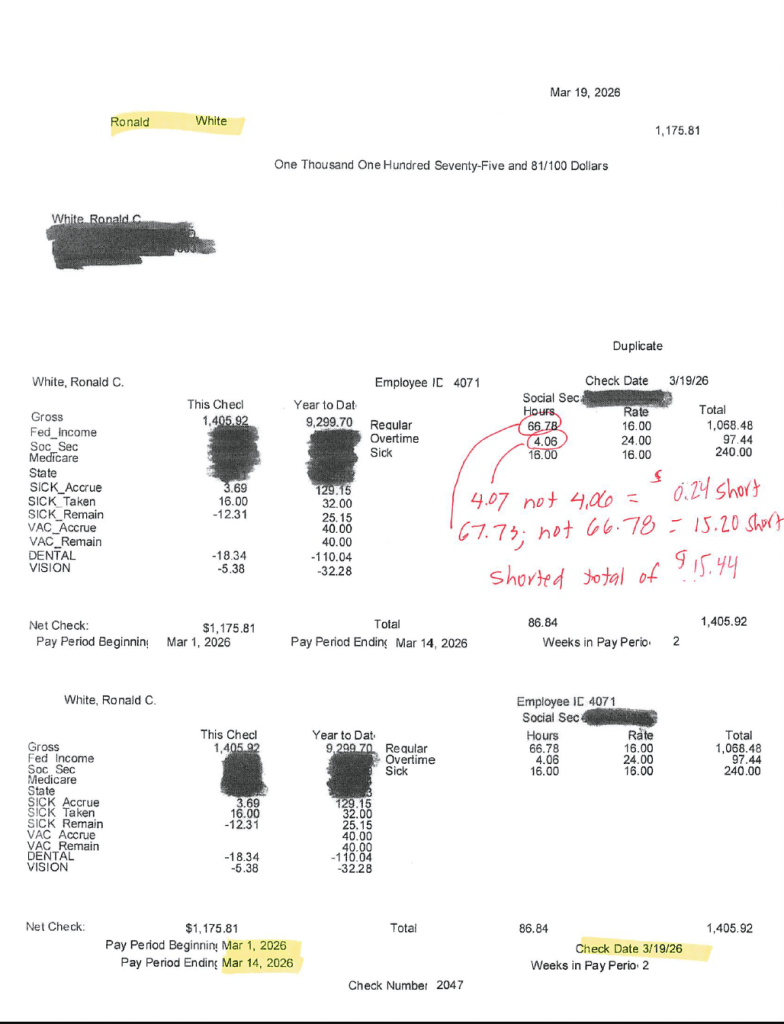
Once more, I used the same calculations as above with the specific punch in and out times, weekly, and bi-weekly totals for Ronald White.
Summary
The county overpaid employees by a total of $39.92. The county shorted employees by a total of $518.59.
Why do the totals and hours that were entered by the county not match what the road employee logged on their time card? Why was one employee shorted all of his OT? Does this reveal a pattern of behavior for incorrect hours and pay entered for each employee by the county personnel responsible for doing so?
Stay tuned for the next publication which will break down each employee’s hours and pay for the pay period that covered March 15, 2026 through March 29, 2026.
If you have a story, feedback, or questions, please feel free to contact me at Plumblyne Productions by email at plumblyneproductions@gmail.com or call me at 229-329-2179. Don’t forget to subscribe, share, and follow to stay up to date.


Leave a Reply